In this article 11 sections
It is Tuesday. A 300-piece polo order is due at the client on Friday, and the carton from your blank supplier is 18 pieces short. Someone on the team remembers this happened last spring too. Nobody wrote it down, so the same supplier got the order again, because they are the one you always use.
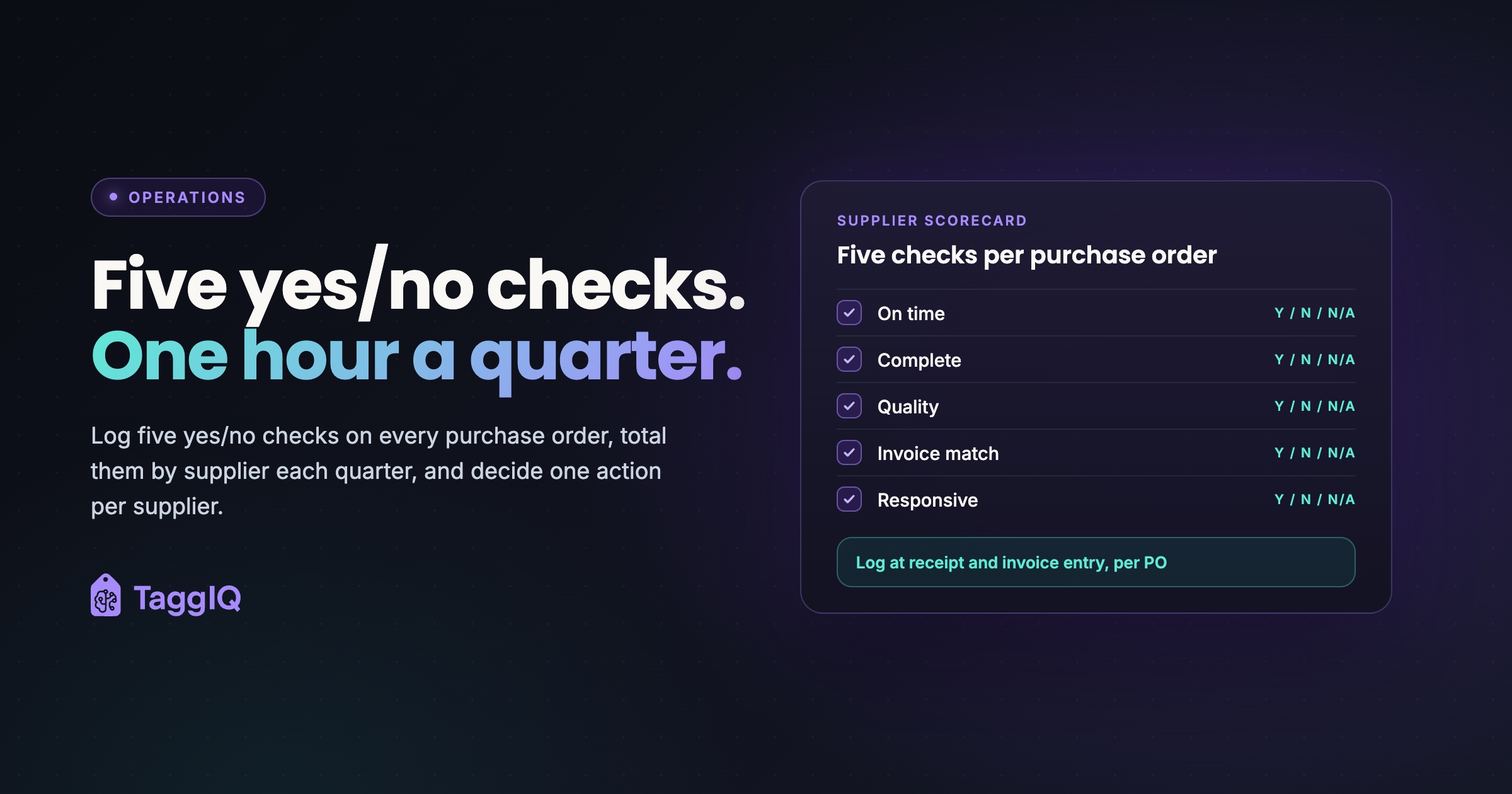
The short answer is that you do not need procurement software or a 20-column spreadsheet. Log five yes/no checks on every purchase order, split between whoever receives the goods and whoever enters the invoice. Total them by supplier each quarter. Then spend one hour each quarter deciding one action for each supplier, with at least one of those reviews landing before peak season. That is enough to replace habit with a record.
Why supplier problems keep repeating
It is easy to choose suppliers by habit, by the price on the day, or by whichever rep answered fastest. When something goes wrong, someone fixes it in an email thread or on a call for that one job. The fix works, but nobody keeps the lesson.
Three things follow from that. Your judgment comes from memory, so the most recent bad job outweighs a year of good ones. What you know sits in one buyer’s inbox and leaves when they do. And price is the only thing anyone can compare, because it is the only thing written down.
Supplier scorecards exist to solve this. The catch for a small shop is keeping one small enough that someone fills it in. For a decorator buying from eight suppliers, every extra column is one more reason the log goes stale, so the one below has five.
The five-measure scorecard
Each measure is a yes or no question, asked once per purchase order. There are no ratings out of ten and no weightings. A yes or no is quick to log and stops arguments about whether something deserved a 6 or a 7.
Split the logging between two people, because nobody sees everything. Whoever opens the box logs On time, Complete and Quality when the goods arrive. Whoever handles purchasing or enters bills logs Invoice match and Responsive on the same PO row when the invoice comes in. The person receiving goods may never see the invoice, which can arrive days later, and has no way of knowing whether the buyer had to chase for tracking.
| Measure | Logged by | The question | Counts as “no” |
|---|---|---|---|
| On time | Receiver | Did it ship by the PO date (or the confirmed date you accepted), according to the tracking or ship notice? | Shipped after the agreed ship date |
| Complete | Receiver | Did the right items arrive in the right quantity? | Short counts, wrong color, wrong size breaks, missing cartons |
| Quality | Receiver | Was it usable without a reprint, replacement or credit? | Damaged blanks, off-shade product, imprint defects on supplier-decorated goods |
| Invoice match | Buyer or bookkeeper | Does the invoice match the PO? | Unit price, quantity, setup or freight charges that differ from the PO |
| Responsive | Buyer | Did they confirm and update you without chasing? | You had to ask for the acknowledgment, ship date or tracking, or waited more than a business day for an answer |
You score the ship date rather than the arrival date because the ship date is what the supplier controls. Transit time depends on the carrier and the shipping method you chose. The receiver confirms the ship date from the tracking or the ship notice, not from the box itself. If the supplier’s acknowledgment confirms a different ship date from the one on your PO and you accept it, score against the confirmed date and record the change in the notes column, so every receiver logs the same order the same way.
The Responsive check borrows from a PPAI Media column on supplier relationships, in which a distributor-side sales manager lists the order acknowledgments, ship-date confirmations and tracking numbers they expect from suppliers.
Separate their fault from yours
This rule keeps the scorecard fair. Suppose the supplier shipped late because your art approval came back two days late. Or the short count matches a typo on your own PO. Neither is a “no.” Mark it N/A and leave it out of that measure’s count.
If you skip this step, you end up scoring suppliers on your own process gaps. The first time you share a score, they will rightly push back. The N/A column is also a diagnostic of its own. If N/As keep piling up on late approvals, the fix belongs in your artwork approval process, not your supplier list.

Anchor it to the purchase order
The purchase order already holds everything the scorecard needs: promised ship date, items, quantities and price. Scoring is just comparing what arrived and what you were invoiced against it. If you skip POs for some suppliers, there is nothing to measure them against, which is one more reason to stop skipping them. Purchase Orders for Promo Shops covers what a usable PO should contain.
Where you keep the log matters less than keeping it in one shared place, never a personal inbox. One row per PO is enough: date, supplier, PO number, five columns of Y, N or N/A, and a short note for every N. Put the instruction at the top of the log so both people see it: log at receipt and invoice entry, per purchase order. It takes a minute or two at receipt and another minute when the invoice is entered. The note is what turns “they’re always late” into “late on 3 of 11 orders, all embroidered caps.”
Run the log for one quarter as a baseline before acting on the numbers. You will find out which checks are easy to log and clear up any confusion about what counts as a no.
Scoring a quarter
At the end of the quarter, each measure becomes a percentage. Divide the yeses by the POs where that measure applied, leaving out the N/As. Between reviews, glance at the “no” notes once a month so a pattern does not wait three months to surface.
Worked example
Your shop placed 48 POs last quarter across seven suppliers. Two of them carry most of the spend.
Supplier A, blanks (14 POs): On time 11 of 13 = 85% (one late ship traced to your own late approval, marked N/A). Complete 12 of 14 = 86%. Quality 14 of 14 = 100%. Invoice match 10 of 14 = 71%. Responsive 13 of 14 = 93%.
Supplier B, imprinted hard goods (9 POs): On time 9 of 9 = 100%. Complete 8 of 9 = 89%. Quality 7 of 9 = 78%. Invoice match 9 of 9 = 100%. Responsive 6 of 9 = 67%.
Look at the patterns rather than an overall average. Supplier A’s product is good, but 4 of the 14 invoices didn’t match the PO. The notes show added freight and a setup charge that was never quoted. Supplier B hits its dates, but two imprint defects needed reprints, and you had to chase three times for tracking. The two suppliers need very different conversations.
Price is one column, not the score
If the only thing you record is price, a cheap supplier with frequent short shipments looks better than it is. The real cost of a problem order shows up as rush freight, rework and client credits, and none of that appears next to the unit price. The Hidden Costs That Quietly Destroy Print Shop Margins covers more of these.
Worked example
Supplier C is $0.40 a tee cheaper than your usual source. On a 200-piece order, that saves $80.
The order arrives 24 pieces short, four days before the in-hands date. You pay $65 to rush the missing pieces. You also spend $40 on screens, emulsion and ink to set up again for a run of 24 shirts. That is $105 in direct cash against an $80 saving.
You also spent about 90 minutes chasing the supplier and rescheduling the press. That time is already on payroll, so count it as lost capacity rather than extra cash. It still came out of some other job. And if the shortage had pushed you past the in-hands date, a client credit would come on top.
Before absorbing those costs, ask the supplier to pay the rush freight or credit the shortfall, and note what was agreed. The Complete check stays a “no” even if you recover the money.
The one-hour quarterly review
Put it in the calendar for the same week every quarter. At least one review should land before your busy season, so the lessons reach the next round of sourcing while you still have time to qualify a backup.
- Sort suppliers by spend. Review your top three to five in full. Look at the rest only if they logged a “no.” A supplier you used twice should not get the same attention as one that carries a third of your purchasing.
- Read the notes behind every “no”. Look for repeats: the same product, the same measure, the same time of year.
- Check your own N/As. If they cluster, write down the internal fix as an action for your own team.
- Decide one action per supplier. Examples: keep as is, ask for invoices to match the PO, move one category to the backup, or test a new backup on a low-risk order.
- Confirm a primary and a backup for each category. Do this for blanks, hard goods, drinkware, sign substrates and anything else you buy regularly.
- Send each key supplier a short note.
Tell the supplier
Scoring a supplier without telling them wastes the most useful part of the exercise. A short, factual note gives them the chance to fix the pattern. For example: “Last quarter we placed 14 orders with you. Product quality was excellent. Four invoices included freight or setup charges that weren’t on our PO. Can we agree that charges match the PO before invoicing?” It is specific, fair and easy to act on.
Primary and backup by category
The review should end with a simple table you keep up to date.
| Category | Primary | Backup | Backup tested on a real order? | Last reviewed |
|---|---|---|---|---|
| Blank tees and fleece | Yes / No | |||
| Caps | Yes / No | |||
| Drinkware | Yes / No | |||
| Sign substrates | Yes / No |
One decision rule matters most here. Never drop a primary after one bad incident unless the backup has already handled a real order. Dropping a supplier with nobody qualified behind them is how shops get stuck in peak season with the one supplier they just fell out with.
Where software fits
The scorecard is a method, not a feature. Your receiver and buyer still log their checks, whatever system you use. A system can keep supplier choice attached to the quote and purchase order. The quarterly review then starts from facts instead of memory. The same goes for your primary and backup table: switching is quicker when both suppliers’ products sit in one place. For TaggIQ’s approach, see its supplier catalog features.
What to do this week
Add the five columns and a notes column to wherever you log incoming goods and supplier invoices. Spend five minutes with both people, whoever receives deliveries and whoever enters supplier invoices, showing each of them what counts as a yes, a no and an N/A for their checks. Put a one-hour review in the calendar for the end of this quarter, and treat the first quarter as your baseline. When you next choose between suppliers for a new product, use a structured comparison rather than whoever answered first.
Get the checklist Download the Supplier Comparison Checklist to compare suppliers on more than price before you place the order.
Frequently asked questions
How is this different from a supplier comparison checklist?
A comparison checklist helps you choose before you buy, using quoted price, stated lead time and capabilities. The scorecard records what actually happened after you bought. Use the checklist to pick a new supplier, then let the scorecard confirm or correct that choice over the next quarter.
What if a supplier disagrees with a "no"?
Share the PO and the note, then look at it together. If the problem traces back to your PO details or a late approval, change it to N/A. Disputes are useful because they show you where the PO or your agreement with the supplier was unclear, and fixing that prevents the next one.
If a supplier scores well on everything, should I give them all my volume?
Concentrating volume with a reliable supplier can improve the pricing and service you get. But keep at least one backup qualified with a real order in every category, so one stock-out or capacity crunch in peak season does not stop your production.
Do I need to log small orders from suppliers I rarely use?
Yes, log them, because it only takes a minute and the record helps if you later consider moving volume to them. In the quarterly review, give them a quick look only when they have a "no." Keep your full attention on the few suppliers that carry most of your spend.

Dave
Dave writes for TaggIQ about running a profitable print, promo, sign and embroidery business: costing and estimating, margins, production flow, order workflows, pricing decisions and keeping customers coming back.