In this article 17 sections
- Start with the job as quoted
- Follow the job from quote to cash
- Spare garments
- Digitising and setup
- Thread, backing and other consumables
- Proof rounds and admin
- Rework: blanks plus press time
- Finishing, packing and freight
- The card fee, on the full amount
- Late payment, the chase and the cash
- What the job actually made
- Is it paying its way? Compare it with your overhead rate
- Card fees: the channel changes the cost
- Why small orders get hit hardest
- The ten-line hidden-cost checklist
- How to run it on last month's jobs
- What to do with what you find
The month was busy. The machines ran most days, invoices went out on time, and the bank balance still looked thinner than the work deserved. The quote is rarely the culprit. The damage comes from small costs that land after it, which nobody prices and nobody records against the job.
The short answer: spares, setup, consumables, admin, rework, finishing, freight, card fees and late payment can take most of the profit on an ordinary job. To find them, audit one job line by line, then ask the same ten questions of last month’s work.
Start with the job as quoted
Take a normal embroidery order for a local business, left-chest logo. Every job figure in this article is illustrative. Only the card fee rates and the payment rules come from published sources.
Worked example: the quote
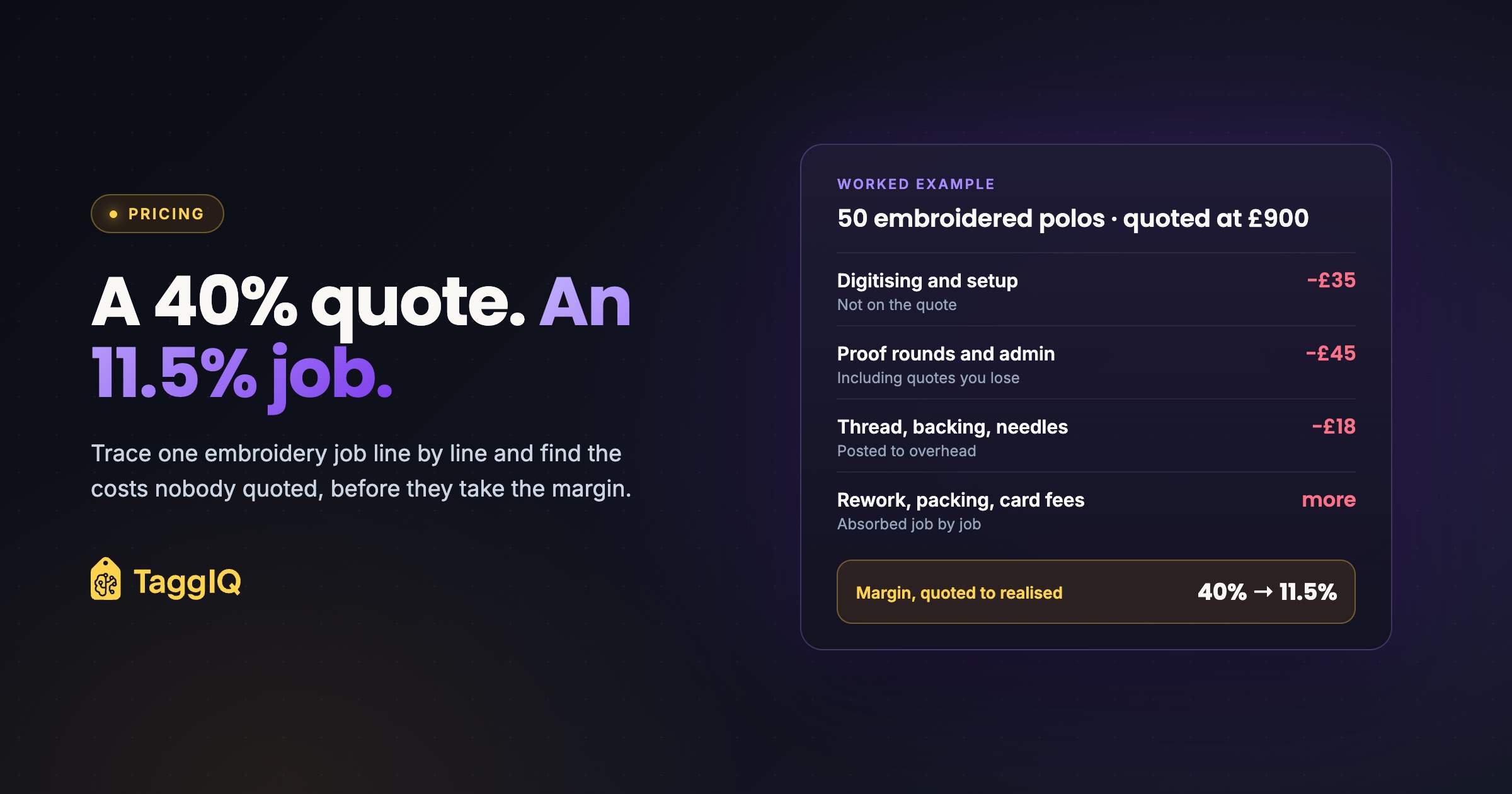
The order: 50 embroidered polos. Blanks: 50 polos at £6.80 each, £340. Embroidery run (machine and operator time): £200. Total quoted cost: £540. Price to the customer: £900 + VAT, so £1,080 gross. Quoted profit: £360. Quoted margin: 40%. Markup check: £360 on £540 of cost is a 66.7% markup but a 40% margin.
Markup is profit divided by cost; margin is profit divided by price. A shop that sets a markup percentage and believes it earns the same percentage as margin starts the month with a gap it cannot see.
Follow the job from quote to cash
Spare garments
If you order a couple of extra garments for a test sew-out or a misprint, that is sensible. The question is whether those spares are charged to the job or quietly absorbed.
Worked example
2 spare polos at £6.80: £13.60. One is used for the test sew-out; the other later covers one of the misprints in the rework step. If you test on scrap fabric instead, only one spare is used and the other goes back into stock.
Digitising and setup
A new logo needs digitising (turning artwork into a stitch file the machine can run), then hooping, thread changes and a test run. If the quote only covers the run, all of this is absorbed. Decoration Pricing: The Hidden Margins in Setup and Run Charges covers how to bill it.
Worked example
Digitising the new logo, outsourced: £25 on the digitiser’s invoice. Machine setup, hooping, thread changes and the test run: 20 minutes at a staff cost of £30 an hour, £10. Total: £35. On a repeat order with an existing stitch file, only the £10 applies.
Thread, backing and other consumables
Thread, backing (the stabiliser hooped behind the fabric), bobbins and needles are bought in bulk, posted to overhead and never charged to a job. On print work the same goes for ink, film, transfer powder and media.
Worked example
54 sew-outs (50 polos, the test and three re-runs) at about 30p each for thread, backing and bobbin: £16.20. A share of needles and trims: £1.80. Total: £18.
Proof rounds and admin
Quoting, a second proof round because the customer wanted the logo slightly larger, chasing approval, raising the invoice. None of it is timed, so none of it is costed. Nor are the quotes that never became orders, and the only place to recover that time is the jobs you win.
Worked example
Quote 15 minutes, two proof rounds 25 minutes, approval chasing 10 minutes, invoicing 10 minutes. 60 minutes at £30 an hour: £30. If about one quote in three converts, each won job also carries 30 minutes of quoting on the two that were lost: another £15. Total: £45.
Rework: blanks plus press time
A few polos come off the machine with the logo sitting too low. The instinct is to count the replacement blanks and move on, but re-hooping and re-running takes machine and operator time that could have gone on paid work.
Worked example
Three polos come off with the logo too low. The held-back spare covers one, so 2 replacement blanks are bought at £6.80: £13.60. 20 minutes of machine and operator time to re-hoop and re-run all three at £30 an hour: £10. Total rework: £23.60, of which most shops only notice £13.60.
Finishing, packing and freight
After the run, someone trims threads, removes backing, checks each polo, then folds, bags and boxes the order. That is rarely quoted. Carriage on the blanks gets posted to overhead and the courier goes on the shop account, so neither is assigned to the job.
Worked example
Trimming, backing removal, checking, folding and bagging at 1.5 minutes a polo: 75 minutes at £30 an hour, £37.50. Bags and a carton: £4. Inbound carriage on the blanks: £12. Courier to the customer, not billed: £9. Total: £62.50.
The card fee, on the full amount
The customer pays through an online payment link. Processors take their percentage on what the customer actually pays, so for a VAT-registered shop the fee falls on the VAT-inclusive total, including VAT that is not yours to keep. One large processor’s published UK pricing lists premium UK cards at 2.8% + 20p and standard UK cards at 1.5% + 20p.
Worked example
Premium UK card on £1,080 gross: 2.8% is £30.24, plus 20p, so £30.44. Worked out on the net £900 instead, it would be £25.40. Calculating on net understates the fee by about £5 on this job alone.
Late payment, the chase and the cash
The invoice says “payment on receipt”, a term the customer never agreed when ordering. They pay weeks later, after reminders and a phone call, long after you paid for blanks and wages.
Under UK late payment rules, if no payment date is agreed, a commercial payment is late 30 days after the customer receives the invoice or the goods, whichever is later, and agreed business terms must usually be within 60 days. Statutory interest is 8% plus the Bank of England base rate, unless your contract sets a different rate. You can also claim a fixed sum for recovery costs, once per late payment: £40 on debts up to £999.99, £70 from £1,000 to £9,999.99 and £100 from £10,000.
Agree payment terms with the customer at quote or order acceptance, not only on the invoice, so both sides know the date. This is general information, so check your own terms and obligations before relying on it.
Worked example
The customer pays 45 days after the invoice. Two reminder emails and a phone call: 30 minutes at £30 an hour, £15. Carrying £1,080 for 45 days on an overdraft at an illustrative 10% a year: £1,080 × 10% × 45 ÷ 365 = £13.32. Total: £28.32. For comparison, the fixed sum on a debt of this size is £70.
What the job actually made
Add the hidden lines back against the quote. All figures are the illustrative ones above.
Worked example: quote against reality
Start from the quoted profit of £360.00 and take off each hidden line: spare garments £13.60; digitising and setup £35.00; thread, backing and consumables £18.00; proof rounds and admin, including lost quotes, £45.00; rework (blanks and press time) £23.60; finishing, packing and freight £62.50; card fee on gross £30.44; payment chasing and cash tied up £28.32.
Realised profit: £103.54. Realised margin: 11.5%.
The job still covered its direct costs. But £256.46 of hidden cost took about 71% of the quoted profit, and the margin fell from 40% to 11.5%.
None of these costs is dramatic on its own; repeated across a month, they explain the thin bank balance.
Is it paying its way? Compare it with your overhead rate
Realised margin is still a gross figure. Rent, power, insurance, software and any office or owner pay not charged to jobs all come out of it. For a benchmark, divide last year’s overheads by last year’s net sales, after a clean-up so nothing is counted twice:
- Take out production wages entirely. The run price and the setup, rework and finishing lines already cover that time.
- Take out consumables, packaging, carriage, courier and card fees, which are now charged to jobs.
- For office and owner time, take out only the part now charged to jobs: admin and chasing minutes per job, times your hourly rate, times last year’s job count. Leave the rest in overheads.
A job below that rate is not paying its full share of overheads, and if that is typical, the business cannot make a profit. When the machines are fully booked, reprice or drop those jobs, because they push out better-paying work. With spare capacity they still help cover fixed costs, so reprice next time rather than turn them away.
Worked example
A shop has £60,000 of annual overheads on £240,000 of net sales from 200 jobs, after that clean-up. The clean-up included removing £12,000 of office time: 200 jobs at about £60 of admin and chasing each. Its overhead rate is 25%, so the polo job’s share is £225. It contributed £103.54, falling short by £121.46. On the quote, at 40%, it looked £135 above its share.
Card fees: the channel changes the cost
Published UK rates differ by channel and by card type. The rates below come from four processors’ public pricing pages as published when this article was written. Rates change, so check your own provider’s current page.
| Channel and card | Published UK rate | Source |
|---|---|---|
| Standard UK card, online | 1.5% + 20p | Processor A |
| Premium UK card, online | 2.8% + 20p | Processor A |
| International card, online | 3.15% + 20p, plus 2% if currency conversion is needed | Processor A |
| In-person UK card, terminal | 1.75% | Processor B |
| Invoice or keyed-in payment | 2.5% | Processor B |
| In-person card, pay-as-you-go | 1.69% | Processor C |
| Standard domestic commercial rate | 2.9% + 30p | Processor D |
Worked example
The same £1,080 payment at each rate in the table: standard UK card online £16.40; premium UK card online £30.44; international card online £34.22 before any conversion charge; in-person terminal £18.90; invoice or keyed-in £27.00; in-person pay-as-you-go £18.25; standard domestic commercial rate £31.62. The same customer paying the same invoice costs you anywhere from £16.40 to £34.22, roughly twice as much at the top, depending on the card and channel.
Why small orders get hit hardest
Fixed per-transaction fees and fixed admin time do not shrink with the order.
Worked example
6 polos for £60 + VAT, £72 gross, paid with a premium UK card online at 2.8% + 20p: a fee of £2.22, about 3.1% of the payment. The same 60 minutes of quoting, proofing and invoicing at £30 an hour costs £30, half the net price.
The ten-line hidden-cost checklist
Run these against last month’s jobs. A reasonable estimate per line is enough to show where margin leaks.
| Hidden cost | Question to ask | Where to find it |
|---|---|---|
| Spares and overs | Were extra blanks or media used, and charged? | Supplier invoice against job quantity |
| Setup, digitising, screens | Billed as a line, or absorbed into the run? | Quote and invoice lines; digitiser’s invoice |
| Test prints and sew-outs | Who paid for the test garment or media? | Supplier invoice and stock count |
| Consumables | What thread, backing, ink, film or media went in? | Consumables invoices divided by units produced |
| Proof rounds | How many rounds, and how many were included? | The email thread |
| Admin, including quotes not won | Minutes on quoting, approvals and invoicing, plus lost-quote time? | Email threads, quote win rate, tally sheet |
| Rework | Replacement blanks plus machine and operator time? | Supplier reorders; tally sheet |
| Finishing, packing and freight | Were finishing minutes, packaging, carriage and courier assigned to the job? | Tally sheet; supplier invoices; courier statement |
| Card fees | Which channel and card, with the fee on the gross amount? | Processor statement or payout report |
| Days to payment | Days from invoice to cash, chasing minutes, cost of the cash? | Invoice date against bank receipt; sent emails |
How to run it on last month’s jobs
- Pick a sample. Last month’s ten largest and ten smallest jobs are enough to see patterns.
- Pull what is recorded. Work through the last column, using one hourly rate for all staff time.
- Tally the time lines. Proof, admin, chasing, finishing and rework minutes are rarely written down. For two weeks, keep one sheet by the machines and one by the desk, a row per job, and use the averages as per-job allowances.
- Recalculate and sort. Subtract the hidden costs from quoted profit, divide by the net price, compare with your cleaned-up overhead rate, then look for repeat offenders by job type, customer and payment channel.
What to do with what you find
Spares and rework that show up on most jobs of one type are a predictable rate, not bad luck, so price them in. If setup and proof rounds are absorbed, add a setup line and state how many proof rounds are included. If small jobs keep landing below target, set a minimum order or a small-order charge; How to Price Promotional Products Without Losing Money covers building those into a price list.
If the same customers pay late, agree terms at order and consider deposits on larger orders. If large invoices are mostly paid by premium or international cards, offering bank transfer may be worth it; check your own bank’s business tariff first.
If you quote in TaggIQ, reporting shows gross margin per order by product category, decoration method and customer, counting blank goods, decoration and shipping. An overdue invoices report lists unpaid invoices by days outstanding. Keep spoilage, admin time and card fees as per-job allowances from your checklist alongside those reports.
Get the margin calculator Put last month's real job figures into the profit margin calculator and see which rows come back thin.
Frequently asked questions
How big should a spoilage allowance be?
Use your own history rather than a rule of thumb. Count misprints and spares used per job type over the last few months, divide by the units produced, and price that rate into future quotes for the same job type. Embroidery on caps and screen printing on dark garments may need very different rates.
What hourly rate should be used for admin and rework time?
Use a loaded rate: wages plus the employment costs you pay on top. For owner time, use what it would cost to pay someone else to do the same work. The point is consistency, so every job is measured the same way.

Dave
Dave writes for TaggIQ about running a profitable print, promo, sign and embroidery business: costing and estimating, margins, production flow, order workflows, pricing decisions and keeping customers coming back.