In this article 9 sections
You quote all day, and more of those quotes now come with a suggested price that looks exact, down to the cent. It looks trustworthy. But a price shown to the cent can still rest on last quarter’s blank cost or a stitch count nobody checked.
The short answer: let software check the arithmetic against your own costs and rules, and keep the judgment for yourself. A margin suggestion is only as good as the cost data behind it. It knows nothing about the customer standing in front of you.
What a margin suggestion is actually doing
A decorated-goods quote is built in layers. You start with the blank garment or substrate cost. Then you add decoration (stitch count bands, color counts, print locations), setup or digitizing fees and any rush charge. Finally you apply a markup or a target margin.
A pricing tool, AI or not, works through the same layers. It can only use what it’s given. If one layer is stale or missing, the final number still looks precise, but it’s wrong. That’s the core risk: the precision tells you nothing about whether the price is right.
If you want a refresher on building the layers themselves, the pricing guide walks through them.
Where software is genuinely useful
These are checks with a clear right answer, given good data and a rule you’ve set. Software doesn’t get tired of them, and a busy person skips them on a Friday afternoon.
| Check | What the software compares | What a flag means |
|---|---|---|
| Margin floor | Quoted margin vs your minimum | Quote is below your floor |
| Stale supplier price | Blank cost on quote vs current price list | Cost has moved since the quote was built |
| Decoration band | Stitch count or color count vs the band charged | Job sits in a higher band than quoted |
| Missing fees | Setup, digitizing, freight, rush lines | A fee your rules expect is absent |
| Missing cost | Any blank or empty cost field | The quote should stop, not guess |
| Outlier price | Quote vs similar past jobs | Price sits far outside your own history |
The last row is where AI adds something beyond fixed rules: it can spot a polo order priced well below your recent polo orders, even when no single rule is broken. Your job history as a pricing guide is the raw material for that check.
The missing-cost row matters most. A tool that fills a missing cost with an estimate produces a confident number with nothing under it. The right behavior is to stop the quote and say which cost is missing.
Where software lacks context
Some pricing decisions depend on things that aren’t in any cost table. A margin tool can’t know them unless a person tells it.
- The relationship. A ten-year account that pays on time may deserve a sharper price than a first-time buyer.
- Reorder likelihood. A pilot order for a 40-location rollout is worth more than its own margin.
- Bid strategy. On a competitive tender you may choose to price lower on purpose.
- Capacity this week. If the embroidery machines are idle, a thinner job still covers overhead. If they’re booked solid, a rush job should cost more, or you should decline it.
- Artwork difficulty. Small text on a performance fabric can mean slower runs and more rejects than the stitch count suggests.
Each of these can push the right price above or below what the cost data says. Overpricing a relationship job loses revenue just as surely as underpricing a strategic one.
The second risk: nobody checks anymore
The bigger danger shows up later. Once suggestions are right most of the time, people stop reading them. This is called automation bias: trusting the machine’s answer by default. Then the one quote with a stale cost goes out unchecked.
NIST’s voluntary Generative AI Profile is guidance on using and evaluating AI with care. A small shop doesn’t need the full framework. It does need a written rule for when a person looks at a quote.
The review rule: exceptions only
Here’s a rule that keeps quoting fast and protects margin:
- Quotes inside your rules go straight out. Floor met, current prices, correct bands, every expected fee present.
- Any flag sends the quote to a named reviewer (you or a senior estimator) before the customer sees it.
- A missing cost always stops the quote. No estimate fills the gap.
- An override needs a written reason and an end date. “Key account, annual program, review at renewal” is a reason. “Felt right” is not.
This sends your time only to the quotes that need judgment. The routine ones stop waiting on you.

One quote, worked through
Worked example
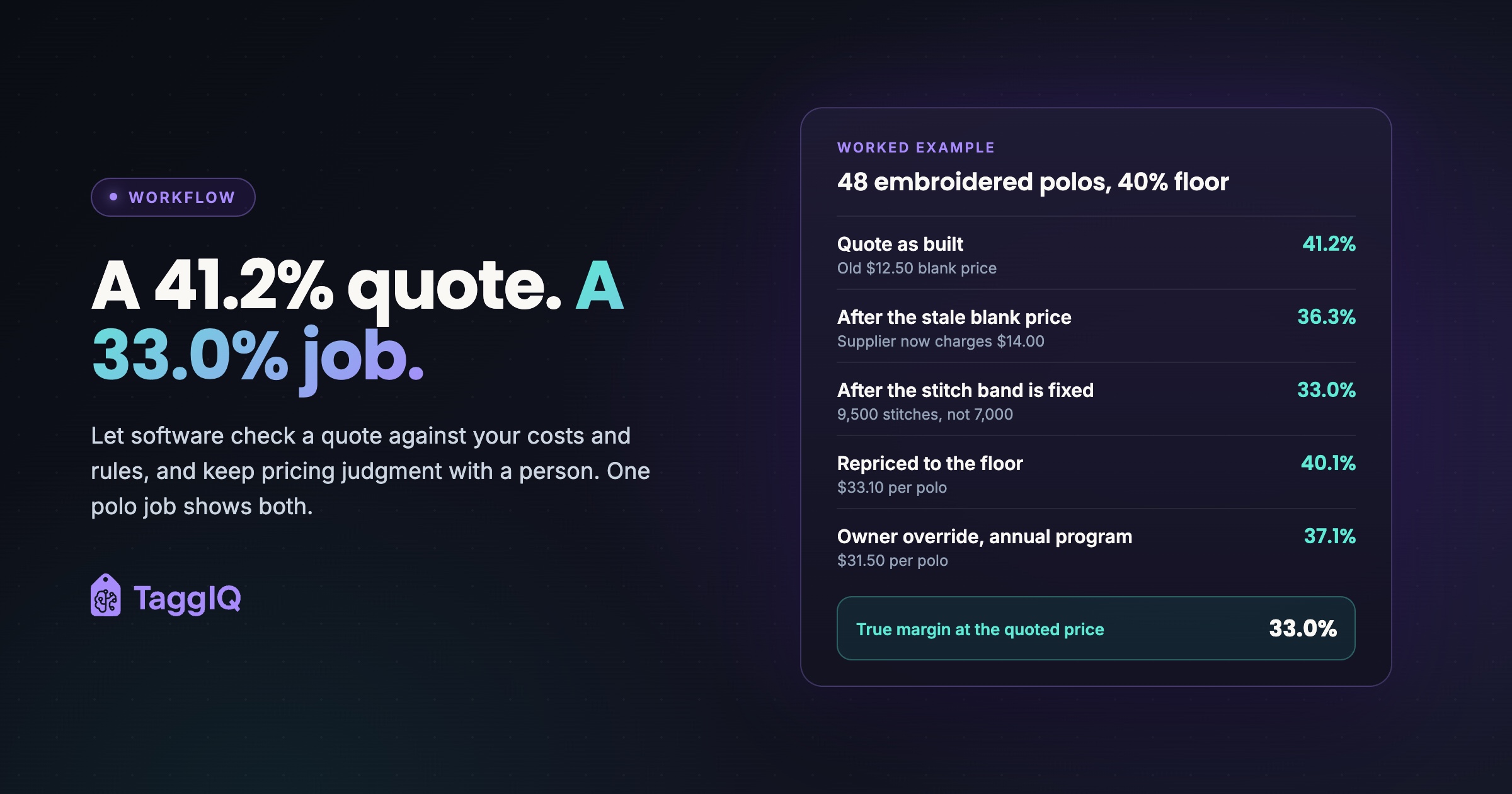
All figures are illustrative. The job is 48 embroidered polos and the shop’s margin floor is 40%. In this shop, job cost means direct costs only: the blank, the embroidery cost per piece (which includes the operator’s machine time and thread), and digitizing.
The quote as built
- Blank cost on the quote: $12.50 each (an old price list)
- Embroidery cost: $4.50 each at the 7,000-stitch band
- Digitizing cost: $40
- Total cost: (12.50 + 4.50) x 48 + 40 = $856
- Price to customer: $29.50 per polo plus a $40 digitizing fee = $1,456
- Margin: (1,456 - 856) / 1,456 = 41.2%. It looks fine.
The one highlighted warning: stale blank price The supplier’s current price is $14.00. That adds $1.50 x 48 = $72 of cost.
- Cost becomes $928. Margin becomes 528 / 1,456 = 36.3%, below the 40% floor.
What the reviewer finds next Checking the digitized file, the design is 9,500 stitches, not 7,000. In this shop’s price list that’s the next band up, costing $5.50 per piece instead of $4.50. That’s another $48.
- True cost: (14.00 + 5.50) x 48 + 40 = $976
- Margin at the quoted price: 480 / 1,456 = 33.0%
Repricing to the floor Total price needed: 976 / 0.60 = $1,626.67. Take off the $40 digitizing fee and divide by 48: $33.06 per polo. Rounded to $33.10, revenue is $1,628.80 and margin is 40.1%.
The human override This is a key account negotiating an annual program. The owner approves $31.50 per polo: revenue $1,552, margin 576 / 1,552 = 37.1%. The reason and a review date at renewal go on the quote.
Notice what happened. The software’s warning caught the stale price. A person caught the stitch band because the stitch count hadn’t been recorded against the quote. And a person made the final price call, because only they knew about the annual program.
Check how the costs are defined, too. In this example, direct production labor sits inside the embroidery cost. Rent, office wages and machine leases are left out, so the margin has to cover them plus profit. If you allocate overhead into job costs instead, set your margin target to match, so no expense is counted twice or left out.
For more on how stitch counts turn into real costs, see embroidery job costing.
Markup is not margin
Check this before you set any floor in a tool.
Worked example
Illustrative figures, using the polo job’s $976 true cost. A 40% markup gives a price of 976 x 1.40 = $1,366.40. The margin on that price is 390.40 / 1,366.40 = 28.6%, well short of a 40% margin floor.
If your rule states a percentage but the tool reads it as markup, a quote can pass the check and still miss your real target. Write the floor down as margin, with the formula next to it: (price minus cost) divided by price. A markup calculator lets you check your own numbers both ways.
A margin review checklist
Use this on any flagged quote, whether the flag came from software or from your own gut.
- Is every blank or substrate cost from the current supplier price list?
- Does the stitch count or color count match the band charged?
- Are setup, digitizing, screens, freight and rush fees present where the job needs them?
- Is any cost field blank or estimated? If so, stop and get the real figure.
- Is the floor calculated as margin, not markup?
- Do your cost definitions match your margin target, so no expense is counted twice or left out?
- Does anything the data can’t see apply: relationship, reorder potential, competitive bid, capacity, artwork difficulty?
- If you’re approving below floor, is the reason written down with a review date?
Update the floor and the price lists your rules depend on whenever a supplier or labor cost changes, and do a fixed monthly sweep to catch any change you missed. A check is only as current as the numbers behind it.
Where to start this week
Pick your last ten sent quotes. Run each through the checklist above and count how many had a stale price, a wrong band or a missing fee. That count tells you how much a margin check is worth to your shop, before you buy any tool.
When you do look at AI tools, judge them by whether they stop on a missing cost and leave the price decision with your team. What you should never let AI decide in your print shop covers where to draw that line.
Margin Agent Compare this checklist with the approach described on the TaggIQ Margin Agent page.
Frequently asked questions
Should I let the software change prices automatically?
No. Have it flag the problem and show what margin a fix would give, then let a named person decide. That keeps the override reasons on record, and that record is what makes the rule work.
What margin floor should I set?
Set it from your own numbers: the floor has to cover overhead and leave the profit you need. Your job history is a better guide than any general figure. Revisit the floor whenever labor or supplier costs change.
How do I stop my team from approving every flag without reading it?
Require a written reason and a review date for each below-floor approval, and read the list of overrides once a month. If the same reason keeps coming up, change the rule instead of repeating the exception.

Emma
Emma writes for TaggIQ about practical AI and automation for print, promo, sign and embroidery businesses: AI assistants and agents, quoting and follow-up workflows, customer experience and keeping people in charge of the decisions that matter.