In this article 13 sections
- How a profitable-looking order loses money
- The five cost layers
- Layer 1: The product at its quantity break
- Layer 2: Decoration setup
- Layer 3: Per-piece decoration
- Layer 4: Freight
- Layer 5: Overheads
- Margin versus markup
- A worked example: 500 embroidered polo shirts
- Free shipping without losing money
- Use the formula, then hold it
- Where an agent fits
- Margin Agent (proposed build)
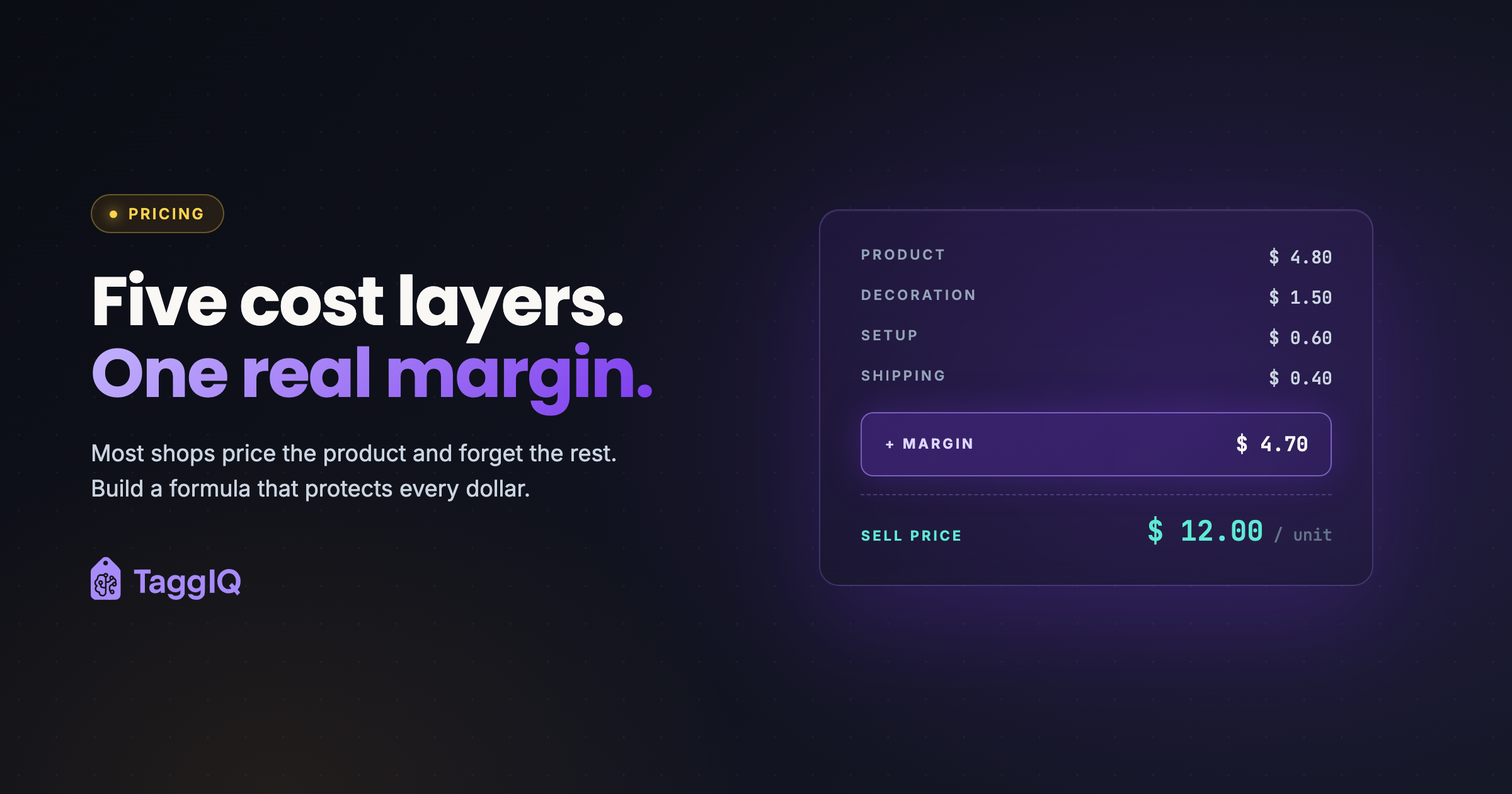
To price promotional products without losing money, price from the effective unit cost, not the blank’s price: add the product at its quantity break, the decoration setup spread over the quantity, the per-piece decoration, the freight and a share of your overheads, then set the price from the margin you need. Most margin leaks come from a layer that never made it onto the quote.
How a profitable-looking order loses money
A common story. A shop prices 300 tote bags from the supplier’s unit cost and adds a healthy markup. Then the decorator’s invoice arrives with a setup charge, a per-piece print charge and freight that were never priced. The order still makes money, but far less than the quote suggested. The markup was right. The cost it was applied to was wrong.
The five cost layers
Layer 1: The product at its quantity break
The blank from your supplier, at the price for the quantity on the quote. Watch the breaks: a quantity just under a break pays the higher price. Either price at the actual break or show the customer what the next break would cost.
Layer 2: Decoration setup
The one-time cost to get ready: screens for screen printing, digitizing for embroidery, plates for pad printing. It is fixed whatever the quantity, so it adds much more per piece to a small order than a large one.
Layer 3: Per-piece decoration
The cost of decorating each item: a run charge driven by colours, stitch count or print size, charged again for each extra location. A second location is the line most often forgotten.
Layer 4: Freight
Promotional products are bulky and heavy. A carton of shirts or a pallet of mugs costs real money to move. If freight is not priced, you pay it.
Layer 5: Overheads
Rent, software, insurance and wages, shared across the jobs you do each month. You do not add a fixed amount to every invoice, but your margins across all jobs have to cover overheads before there is any profit.
Margin versus markup
They are not the same, and mixing them up costs money.
- Markup is based on cost. A 50% markup on a 10.00 cost gives a price of 15.00.
- Margin is based on the price. On that 15.00 sale the margin is 33.3% (5.00 profit divided by 15.00).
The formulas:
- From markup: price = cost × (1 + markup)
- From margin: price = cost ÷ (1 − margin)
If you want a 40% margin on a 10.00 cost: 10.00 ÷ 0.60 = 16.67, which is a 66.7% markup. Apply a 40% markup instead and you get 14.00, a margin of only 28.6%.
Think in margin. It tells you what share of each sale you keep.
A worked example: 500 embroidered polo shirts
The figures below are illustrative, not real supplier prices or market averages. US dollars, excluding tax.
| Cost layer | Per unit | Total for 500 |
|---|---|---|
| Polo shirt at the 500-piece break | 8.75 | 4,375.00 |
| Embroidery digitizing, one time | 0.17 | 85.00 |
| Embroidery run, left chest | 2.10 | 1,050.00 |
| Freight, three cartons | 0.38 | 189.00 |
| Effective unit cost | 11.40 | 5,699.00 |
At a 40% margin: 11.40 ÷ 0.60 = 19.00 per shirt, a quote total of 9,500.00 and a gross profit of 3,801.00.
Now the mistake: apply the same 40% margin to the shirt’s 8.75 alone and the price is 14.58. Against the real 11.40 cost, that is a quote total of 7,290.00, a margin of about 21.8%, and 2,210.00 less profit on the job.
The worked automated quote example prices a smaller embroidery job the same way and includes a CSV you can download. The decoration pricing guide goes deeper on layers 2 and 3.
Free shipping without losing money
Customers ask for it often. Three ways to handle it:
- Build freight into the unit price before applying your margin. The customer sees one price.
- Show freight as its own line. Useful on large orders where freight is significant.
- Offer free shipping above a threshold only when your prices already carry it.
What not to do: absorb freight as an afterthought on a job that was already thin.
Use the formula, then hold it
The hard part is not the maths. It is using the same method on every quote, including when a customer pushes back. When you know your effective unit cost and the margin you need, you know exactly how far you can move before the job stops being worth doing.
Where an agent fits
You can start with one custom AI agent around the tools you already use. The TaggIQ platform is optional.
Margin Agent (proposed build)
For your shop, we could build a Margin Agent that checks each draft quote against your margin floor and your cost lists, and flags a missing layer, such as freight or a second location, before the quote goes out. It does not invent costs and it never changes a price. Your rules do the maths, and your team decides.
If margin is the job you would hand over first, the assessment below is where we look at it with you.
Prakash
Founder of TaggIQ. He built POS, commerce and AI platforms at Toast and VMware/Broadcom, and is building AI agents and an AI-native platform for print, promo, sign and embroidery shops from close trade conversations and workflow research.