In this article 10 sections
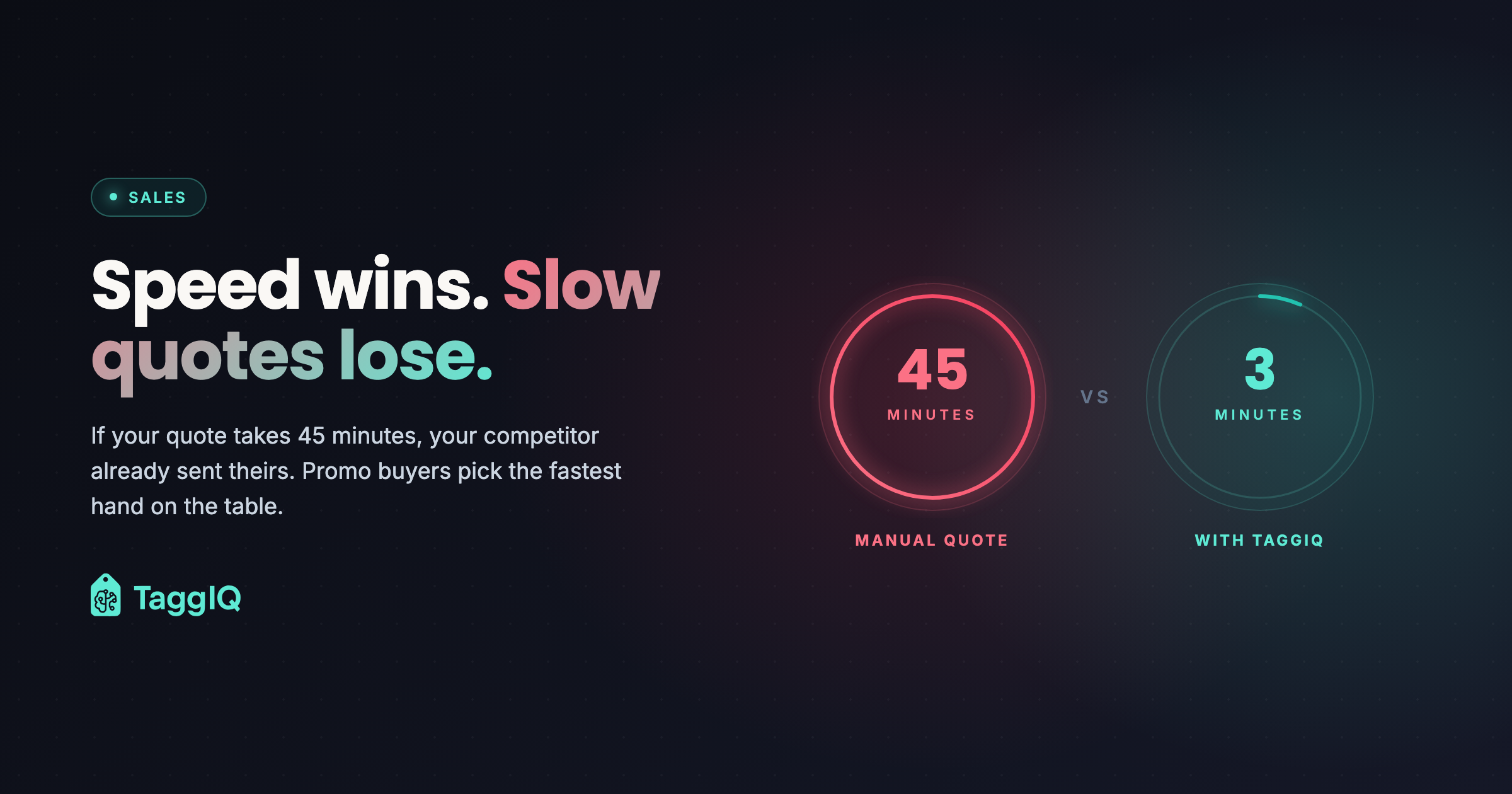
A slow quoting process loses jobs because buyers of promotional products often ask several shops at once and go with a clear answer that arrives first. The fix is to take the manual steps out of each quote, so an accurate price goes out quickly, and to make sure every quote that goes quiet is followed up.
How a quote gets lost while it is being made
A familiar sequence. A customer emails in the morning asking for a price on branded water bottles. Someone checks suppliers, compares quantity breaks, works out decoration, formats a quote and sends it an hour later. By then the customer has already replied to another shop: “let’s go with this.”
The price was fine. The other shop was simply first with a clear answer.
Where the time goes
In most shops a quote is a chain of manual steps:
- Find the product. Search one or more supplier websites, check colours and stock, check the decoration fits.
- Get the costs. Find the quantity break, the setup charge and the run charge, and any extras for colours or sizes.
- Do the maths. Add it up, apply the markup, check it again.
- Format it. Copy the lines into a template, add terms, export a PDF, proofread.
- Send it. Write the email, attach the file, send.
Each step is quick on its own. Together, on every quote, they take most of a morning.
What slow quoting really costs
Fewer wins
The longer a request waits, the more replies the customer already has. A quote that arrives the next day is competing as a late option.
Fewer quotes sent
If every quote takes a long time, there is only time for so many. Fewer quotes out means fewer orders in.
Small jobs skipped
When quoting is slow, people start choosing which requests to answer. Small requests get skipped, and some of those would have become regular customers.
Fast without being sloppy
Fast does not mean a price in a text message. It means an accurate, professional quote without the manual steps:
- Supplier costs already in the system, so picking a product brings its price and breaks with it.
- Decoration priced by rule, so setup and run charges are never forgotten.
- Your markup applied by rule, with the margin shown before you send.
- A clean quote document in one step, not a retyped template.
A wrong quote sent quickly is worse than a right one sent slowly. When the rules do the arithmetic, accuracy is built in and speed follows. The worked automated quote example shows those rules applied to one job, line by line.
If you use the TaggIQ platform, supplier catalogs come through the SourceIQ supplier data layer, tier pricing is built in, and an accepted quote becomes the order and invoice without re-keying.
The quote nobody chased
Speed at the start is half of it. The other half is the quote that went out and heard nothing back. Follow-up happens when someone has time, so one customer gets three reminders and another gets none.
Where an agent fits
You can start with one custom AI agent around the tools you already use. The TaggIQ platform is optional.
Quote Agent (proposed build)
For your shop, we could build a Quote Agent that reads your open quotes and whether the customer has replied, drafts a follow-up in your voice for you to approve, and stops as soon as the customer answers. It never changes a price. It drafts alongside you, and a person decides what is sent.
If follow-up is the job you would hand over first, the assessment below is where we look at it with you.
Prakash
Founder of TaggIQ. He built POS, commerce and AI platforms at Toast and VMware/Broadcom, and is building AI agents and an AI-native platform for print, promo, sign and embroidery shops from close trade conversations and workflow research.