In this article 17 sections
- Why this is worth an afternoon
- How to see your shop from the outside
- The ten moments and what to look for
- 1. Enquiry
- 2. Quote
- 3. Quote follow-up
- 4. Order confirmation and sizes
- 5. Artwork proof and approval
- 6. Production updates
- 7. Collection or delivery
- 8. Invoice and payment
- 9. Aftercare check
- 10. Reorder prompt
- The audit sheet
- Fix the lowest two first
- Make the fixes stick
- Your next step this week
You know your repeat customers by name, and the jobs go out right. Yet some accounts drift away, a few quotes vanish without a reply, and the phone keeps ringing with “is it ready yet?” From inside the shop, nothing looks broken, because you and your team know exactly how the process works. Your customers don’t.
The short answer: audit the experience from the outside. Break the journey into ten moments, score each one from 1 to 5 as the customer would feel it, and fix the lowest two first. It takes an afternoon, and it turns a vague sense that “service could be better” into a short, specific to-do list.
Why this is worth an afternoon
Service is a fair basis for competing, not only price. In the January 2026 UK Customer Satisfaction Index from the Institute of Customer Service, 35.6% of customers said they preferred excellent service even if it costs more, up 4.3 points on a year earlier. The same index put overall satisfaction at 78.2 out of 100 and found 83.2% of experiences were right first time, the highest it has recorded.
That last figure sets the bar your customers bring with them. They compare your shop with every other organisation they deal with, not with other print shops. A proof that needs three emails to clarify, or an invoice they have to hunt for, feels slow against that bar even if the embroidery is perfect.
For a custom print or embroidery business, the stakes are commercial. If your repeat B2B work comes from uniforms, clubs and events, look hardest at the late moments of the journey: aftercare and the reorder. Chasing calls about status, proofs and sizes also take staff time away from production.
How to see your shop from the outside
You need a customer’s eyes, not a manager’s. Two simple ways to get them:
- Mystery-shop yourself. Send a test enquiry from a personal email address or through your website form, as a small business wanting 25 embroidered polos. Note how long the reply takes, what it asks, and how easy the quote is to read and accept.
- Ask a friendly customer. Pick a loyal account and ask them to talk you through their last order, moment by moment. Ask “what did you have to chase?” and “where did you have to wait without knowing why?”
Score each moment while the experience is fresh. Use the customer’s point of view, not your intentions. If your process says “we update customers during production” but the customer heard nothing for eight days, that moment scores low.

The ten moments and what to look for
Use this scale for every moment:
| Score | What it means from the customer’s side |
|---|---|
| 1 | Missing or frustrating; the customer had to chase or gave up |
| 2 | Happened, but slow, unclear or the customer had to ask |
| 3 | Fine; nothing went wrong, nothing stood out |
| 4 | Clear and timely; the customer knew what was happening |
| 5 | Effortless; it felt like the shop was a step ahead |
Ten moments at up to 5 points each gives a total out of 50. The total matters less than the shape: where the low scores sit.
1. Enquiry
How quickly does a real person reply, and does the reply move things forward? A strong first response asks the questions you need for a quote (garment, quantity, decoration, deadline, artwork) in one go. Set yourself a target, such as replying within one working day, and test against it.
2. Quote
Can a buyer understand the quote without ringing you? Check that setup charges, decoration positions, quantities and lead time are in plain words, and that there is one obvious way to say yes.
3. Quote follow-up
Every unanswered quote is work you have already priced and may never win. Look at your last ten quotes: how many got a polite follow-up? If the honest answer is “the ones I remembered”, this moment scores 2 at best. The quote follow-up guide covers timing that doesn’t feel pushy.
4. Order confirmation and sizes
Does the customer get a written summary of what they ordered, when it will be ready and what you need from them next? For team or staff apparel, how are sizes gathered? Collecting sizes through one shared form beats a long email thread where the counts change twice.
5. Artwork proof and approval
A good proof leaves no room for argument about colours, sizes, placement or quantities. It offers one clear action, approve or request changes, and the decision is recorded. Unclear proofs lead to disputes, reprints and write-offs, so this moment protects margin as well as goodwill. The detail is in why artwork approvals go wrong over email.
6. Production updates
Silence at this stage is invisible to you. Nobody in the shop is worried; the job is on the schedule. The customer only knows they paid a deposit and heard nothing. Proactive updates using plain stage names (“in production”, “ready to collect”) rather than internal jargon cut “where is my order” calls. The customer update rhythm sets out when to send them.
7. Collection or delivery
Does the customer know exactly when and how the order arrives? For collection, do they know opening hours, where to park and who to ask for? Check that the goods are packed so the buyer can hand them out easily, for example bagged by name or by size for a team order.
8. Invoice and payment
Can the customer find the invoice and pay it in under a minute, with the order details alongside? An invoice that arrives separately from any order context, or a payment link buried in an old email, slows payment and creates admin for both sides.
9. Aftercare check
A short message a few days after delivery: did everything arrive, does it look right, is anything needed? It catches problems while they are small, and it tells the customer you care about the result, not only the sale.
10. Reorder prompt
Uniforms wear out, staff join, and events come round every year. If nobody contacts the customer at the right time, the reorder is left to chance, or to whichever shop gets in touch first. Look at your order history for recurring items and set a reminder before each one is due; spotting reorder opportunities shows how to find them.
The audit sheet
Copy this into a spreadsheet or onto paper. Fill in one row per moment.
| # | Moment | Customer’s question | Score (1 to 5) | Evidence (what actually happened) | One fix |
|---|---|---|---|---|---|
| 1 | Enquiry | “Did anyone get back to me?” | |||
| 2 | Quote | “Do I understand what I’m paying for?” | |||
| 3 | Quote follow-up | “Did they want my business?” | |||
| 4 | Confirmation and sizes | “Do they have exactly what I ordered?” | |||
| 5 | Proof and approval | “Is this what it will look like?” | |||
| 6 | Production updates | “Where is my order?” | |||
| 7 | Collection or delivery | “When and how do I get it?” | |||
| 8 | Invoice and payment | “How do I pay this?” | |||
| 9 | Aftercare check | “Do they care how it turned out?” | |||
| 10 | Reorder prompt | “Will they remind me next time?” |
The evidence column keeps the audit honest. “Customer emailed twice asking for status” is evidence; “we usually send updates” is not.
Fix the lowest two first
Trying to fix all ten moments at once spreads your attention so thin that nothing changes. The rule is simple: pick the two lowest scores, fix those properly, and re-audit in a month or a quarter. If two moments tie, start with the one closest to money: a missed reorder or an unchased quote costs more than slightly vague collection details.
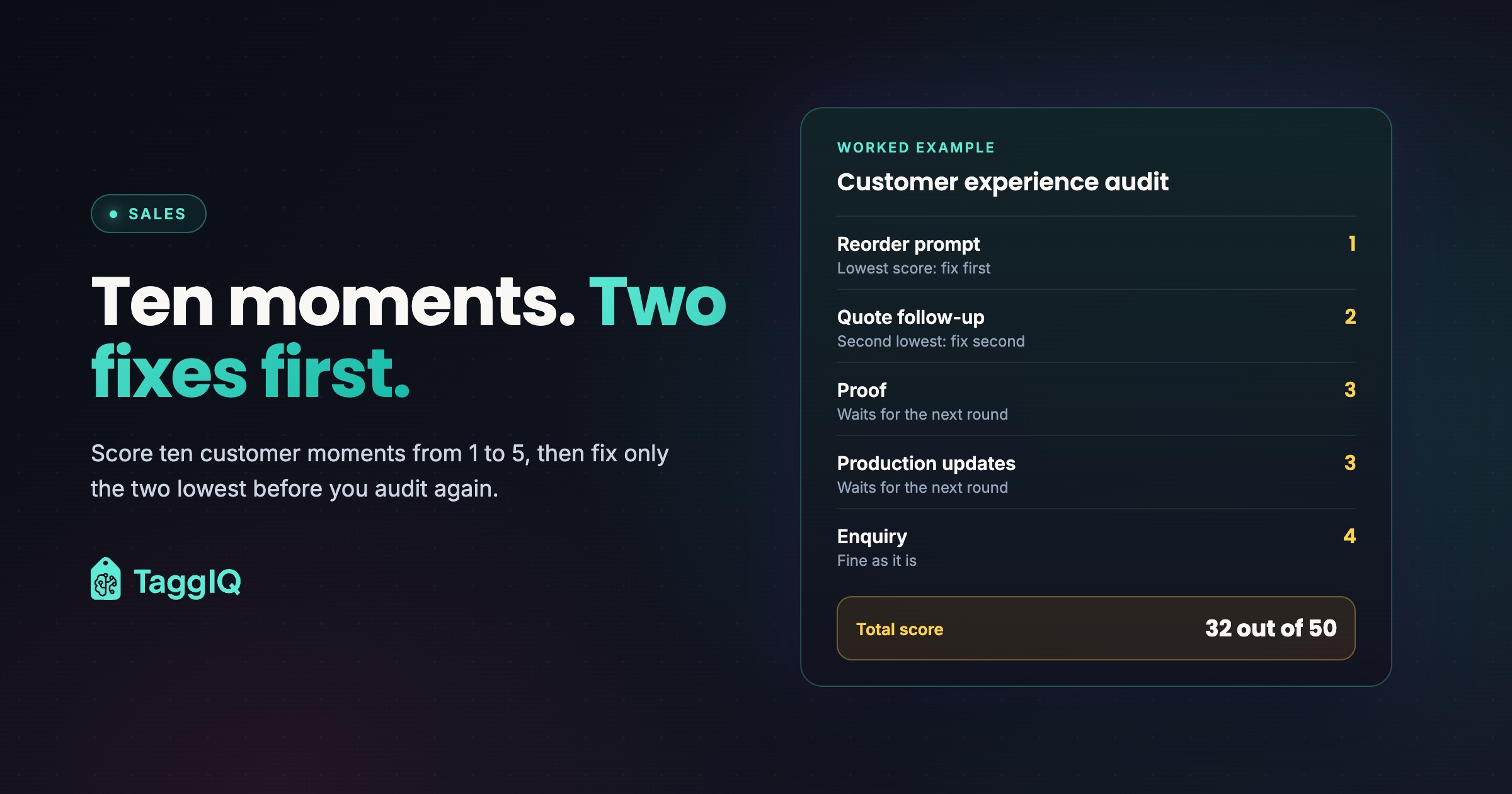
Worked example
A UK embroidery and print shop handles about 40 orders a month, mostly repeat B2B workwear. The owner mystery-shops the enquiry and asks two regular customers to walk through their last orders.
Scores: enquiry 4, quote 4, quote follow-up 2, confirmation and sizes 4, proof 3, production updates 3, delivery 4, invoice 4, aftercare 3, reorder prompt 1. Total: 32 out of 50.
The two lowest are the reorder prompt (1) and quote follow-up (2). Production updates and the proof both sit at 3, so they wait for the next round.
Fixes for the month: (1) list every workwear customer who ordered more than once, note when they last ordered, and set a reminder to contact each one before their usual reorder point; (2) send one friendly follow-up on every open quote after a set number of working days, written once as a template. Next audit, the owner checks whether those two moments have moved to 3 or above.
Notice what the example does not do. It does not redesign the proof process, buy new equipment or rewrite every email. Two fixes, both doable in a week, both tied to income the shop was already close to winning.
Make the fixes stick
A fix that depends on someone remembering will slip in a busy week. For each change, decide three things: who owns it, what triggers it (a date, a job status, a quote age), and where it is recorded so you can see it happened. Write it on the audit sheet’s “one fix” column so next quarter’s audit starts from the last one.
Several of the ten moments are about the customer being able to see and act without asking you: checking a status, approving a proof, accepting a quote, paying an invoice, sending sizes. If those moments keep scoring low, a customer portal can carry them. In TaggIQ’s customer portal, customers follow an order timeline built from the stages you choose to show, with friendly labels if you want them. They approve proofs or request changes with the decision logged against the job, accept or decline quotes, and pay invoices online when payment is connected. A “needs your attention” list gathers pending proofs, unpaid invoices and open quotes, and sizes come in through one shared link with exact counts returned to your team. Reorder reminders are still a job for your own calendar or order history review.
See the customer portal See how a customer portal handles status, proofs, quotes, sizes and payment so customers stop having to chase.
Your next step this week
Block out one afternoon. Send a test enquiry, call one loyal customer, fill in the ten rows with evidence, and circle the two lowest scores. Put one owner and one trigger against each. That is the whole audit, and it will show you more than another month of guessing from behind the counter.
Frequently asked questions
How often should a print shop repeat the audit?
Re-score after your two fixes have had time to run, for example a month for quote follow-up and a full reorder cycle for reminders. A quarterly rhythm keeps it light enough that you actually do it.
Should staff score the moments, or only customers?
Let staff score too, then compare. The gaps between your team's scores and the customer's scores point to the moments that are invisible from inside the shop, which is exactly what the audit is for.
What if a customer gives a low score to something we think we do well?
Treat their experience as the evidence. Ask what they saw at that moment, then check whether your process actually reached them, for example whether the update was sent but went to someone who had left the company.
Does this work for sign shops and promo distributors too?
Yes. The moments stay the same; the details change. A sign shop might fold site survey and installation into collection or delivery, and a promo distributor might treat product samples as part of the proof.

Emma
Emma writes for TaggIQ about practical AI and automation for print, promo, sign and embroidery businesses: AI assistants and agents, quoting and follow-up workflows, customer experience and keeping people in charge of the decisions that matter.