In this article 11 sections
Your biggest customers email when they need something, you turn it round, and everyone is happy. Meanwhile their marketing team buys conference merchandise from someone else, their second site orders its own workwear, and you only find out when a van turns up wearing a logo you didn’t stitch.
The fix is a short, regular conversation. Once a quarter, sit down with each large customer for 30 minutes, bring their order history, and talk about their next three months rather than your product list. This article gives you the agenda, the prep sheet and a worked example you can copy this week.
Why reactive service caps your best accounts
When you only respond to orders, you only see the part of the account that already comes to you. You don’t see the departments that have never heard of you, the events planned for next spring, or the category they buy from another supplier because nobody asked.
There is a production cost too. A reorder you could have planned for a quiet week arrives as a rush job in your busiest one. And if a large account is quietly unprofitable, or slow to pay, you won’t notice until it hurts.
An account review fixes all three. It is not a sales pitch. It is a look at the customer’s own calendar with the data in front of you both.

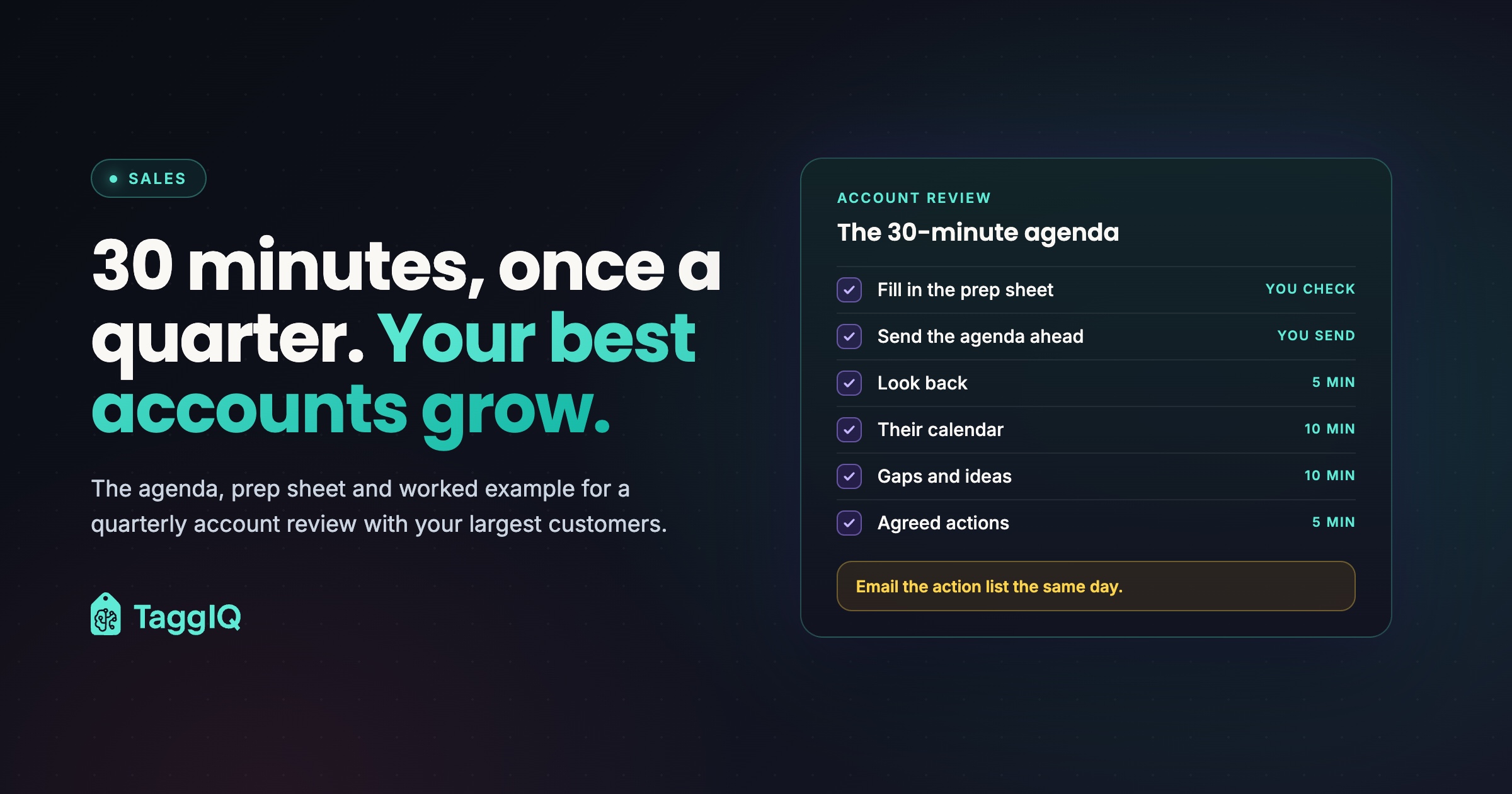
The 30-minute agenda
You don’t need a slide deck or a long meeting. For a facilities manager or office manager buying workwear, thirty minutes, well prepared, is enough.
| Time | Section | What you’re after |
|---|---|---|
| 5 min | Look back | What they bought, what went well, anything that went wrong |
| 10 min | Their calendar | Events, new starters, rebrands, site openings, seasonal peaks in the next 3 to 6 months |
| 10 min | Gaps and ideas | Departments, sites and categories not buying from you yet |
| 5 min | Agreed actions | Who does what, by when |
Look back (5 minutes)
Keep it short. Name the main orders, mention one thing that went well and ask directly whether anything frustrated them. If there was a late delivery or a remake, raise it before they do. This is also the natural moment to mention an overdue invoice, calmly and as a matter of housekeeping.
Their calendar (10 minutes)
This is the heart of the meeting. Ask open questions and write the answers down:
- What events do you have coming up in the next six months?
- Are you taking on new staff, and when do they start?
- Any new sites, vehicles, rebrands or uniform changes planned?
- When do your budgets reset?
Don’t assume you know. The customer who bought polos last spring may have switched to a different uniform policy since.
Gaps and ideas (10 minutes)
Now bring in what your prep sheet showed you. “You order embroidered workwear for the warehouse team. Who handles printed materials for your sales team?” One or two targeted questions beat a catalogue. If you want a lighter touch for this part, the approach in cross-selling without being pushy fits well here.
Agreed actions (5 minutes)
Every review ends with a short list: the action, the owner, the date. Send it by email the same day. The first five minutes of the next review is checking that list, so you never start from zero.
The one-page prep sheet
Preparation is what makes 30 minutes enough. Before you meet the customer, spend 20 minutes with your own records. Kapta, which writes on key account management, recommends an internal account review as a preparation step and suggests a quarterly rhythm for key accounts and every six months for smaller ones.
Fill in these fields for each account:
| Field | Why it matters |
|---|---|
| Revenue this quarter vs same quarter last year | Spots growth or quiet decline |
| Order count and average order size | Shows whether they order little and often or in big batches |
| Gross margin on the account | Tells you if growing it is worth it |
| Top products and decoration methods | Shows what they trust you for |
| Reorders due in the next quarter | Lets you plan production and stock |
| Open quotes | Things to chase or close |
| Overdue invoices | Cash to collect in a friendly way |
| Contacts and departments buying | Reveals who isn’t buying yet |
The last field matters most for growth. List every person who has placed an order and their department. The gaps are your conversation. If your team struggles to keep this kind of history in one place, the customer context problem is worth reading before your first review.
A worked example
Worked example
A logistics firm has placed 14 orders with you in the last 12 months, worth £18,400 in total. Average order size is £18,400 ÷ 14 = about £1,314.
By quarter: Q1 had 5 orders (£6,200), Q2 had 6 orders (£8,900), Q3 had none, and Q4 so far has 3 orders (£3,300). That adds to 14 orders and £18,400.
Almost everything is embroidered workwear for the warehouse team, ordered by one facilities manager. Gross margin on the account is 38%, so about £6,992 over the year, which is healthy enough to grow. One invoice of £1,150 is 21 days overdue.
Your prep sheet raises three questions: why was Q3 empty, who buys for the other departments, and when is the next intake of warehouse staff?
In the meeting, the facilities manager explains Q3 was quiet because they ran down stock before a uniform colour change. They also mention an annual conference in March, organised by marketing, and a new-starter intake every September.
Worked example
Agreed actions from that 30-minute review:
- You send a sample of the new colour polo by Friday (owner: you).
- The facilities manager introduces you to the marketing lead about the March conference (owner: customer).
- You pencil in a new-starter kit run for the first week of August, a quiet production week for you (owner: you).
- The overdue £1,150 invoice is passed to their accounts team today (owner: customer).
Two of those actions are new revenue that would otherwise have gone elsewhere. One evens out your production calendar. One brings in cash.
Notice that the growth came from listening, not pitching. The conference and the September intake were in the customer’s calendar all along.
Before the meeting: share the agenda
Send the agenda a few days ahead and ask what they’d like to add. Kapta’s guidance on QBR preparation recommends sharing the agenda in advance and inviting the customer to add items, so they arrive having thought about their part.
A simple email works:
“Hi Sarah, could we book 30 minutes next week for a quick account review? I’d like to cover how the last few months went, what’s coming up for you over the next six months, and anything we could make easier. Is there anything you’d like to add?”
Ask them to bring dates for upcoming events and staff intakes if they have them. That one request turns a chat into a planning session.
Common mistakes to avoid
Turning it into a pitch. If you spend the 10 minutes on gaps reading out your product range, you give the customer a reason to decline the next invite. Ask about their plans first, then suggest.
Arriving without data. “How’s everything going?” gets “fine”. “You haven’t ordered since June, is that the uniform change?” gets a real answer.
Ignoring margin. A big account with thin margins doesn’t need more of the same work. Check the margin line before offering anything new, and look at decoration margins if one method is dragging the number down.
Skipping the follow-up. Agreed actions with no email afterwards are forgotten by the following Monday.
Making it too long. Thirty minutes is a promise. Keep it, and the customer will say yes again next quarter.
Your next step this week
Pick your three largest accounts. For each one, block 20 minutes to fill in the prep sheet from your order and invoice records, then send the agenda email. Book the reviews for the next two weeks. After the first round, you’ll have a list of agreed actions, a clearer view of which accounts are worth growing, and probably at least one department you didn’t know existed.
If pulling the prep sheet together means opening five spreadsheets, a reporting tool can do the heavy lifting. TaggIQ’s reporting shows lifetime value, order frequency and average order size per customer, gross margin by customer and decoration method with period-over-period comparison, and overdue invoices by days outstanding, all exportable to PDF for the meeting.
See TaggIQ reporting Build your account review prep sheet from customer, margin and invoice reports in one place.
Frequently asked questions
How many customers should get a quarterly review?
Start with the handful whose loss would hurt most, such as your top three to five by revenue or margin. For the next tier down, a six-monthly review keeps the habit going without doubling the workload.
What if the customer says they don't have time?
Offer 20 minutes on a call instead of a visit, and send the prep sheet highlights beforehand. A shorter review with good data is better than no review.
Should I bring prices or a quote to the meeting?
Not as the main item. Bring order history and questions. If a clear need comes up, agree to send a quote afterwards and add it to the action list with a date.
Who from my shop should attend?
Whoever owns the relationship, plus the owner for your largest account if possible. Keep it to one or two people so it feels like a conversation, not a presentation.

Dave
Dave writes for TaggIQ about running a profitable print, promo, sign and embroidery business: costing and estimating, margins, production flow, order workflows, pricing decisions and keeping customers coming back.