In this article 10 sections
- Why the same remakes keep coming back
- Step 1: Log every remake with a cause and an owner
- Use a fixed list of causes
- Keep cause and owner in separate columns
- Step 2: Cost each remake fully
- Step 3: Rank causes and fix only the top one
- Step 4: Write your reprint policy from the log
- Reprint policy checklist for your advisor
- Internal rules for blanks, transit damage and goodwill
- What to do this week
A shirt order comes back with twelve pieces in the wrong size. You remake them, ship them, and move on, because keeping the customer matters more than winning the argument. Next month it happens again, and nobody can say if it’s the same problem, what it cost, or whose fault it was.
The short answer is general practice, not legal advice: check your obligations with a qualified advisor in the states where you sell, and don’t treat an approved proof or signed agreement as settling who pays on its own. Under clear terms, the shop pays for errors its own process caused, and the customer may pay for errors that showed on a proof they approved. To stop paying, keep a remake log that records cause and owner separately, and write your customer policy from what it shows.
Why the same remakes keep coming back
Remakes get run quietly and never written down, so there’s no count. When they are written down, everything goes in as “misprint,” which hides any pattern. And cause gets mixed up with blame. The press operator takes the heat for a job that was already wrong at order entry, so the real fix never happens.
Step 1: Log every remake with a cause and an owner
A spreadsheet is enough. Add one row per remake on the day it happens, not at month end.
| Column | What goes in it |
|---|---|
| Date | The day the problem was found |
| Order number | So you can pull up the quote, proof and work order |
| Customer | Shows whether one account drives the count |
| Decoration method | Screen print, embroidery, direct-to-film, vinyl, sign |
| Pieces affected | Only the pieces remade, not the whole order |
| Cause category | One from the fixed list below |
| Owner | Provisional: shop, customer, supplier, carrier or unresolved |
| Paid by | Who actually paid in the end |
| Full remake cost | Built up as in Step 2 |
| Note | One line on what happened |
Use a fixed list of causes
Put every remake into exactly one of these:
- Order entry error: wrong sizes, colors or quantities on the work order
- Artwork or proof error: spelling, layout, wrong logo version, a revision nobody approved
- Production error: registration, placement, thread breaks, under-curing
- Supplier or blank defect: holes, stains, wrong item received
- Shipping damage: lost or damaged in transit
- Customer changed their mind: the job was right, but they wanted something else
Keep cause and owner in separate columns
Cause is what went wrong. Owner is your provisional view of who’s responsible, pending a review of the proof, your agreed terms and your obligations. A spelling mistake is an artwork error. If the customer approved a written proof showing the mistake, the provisional owner is the customer; if approval was verbal, mark the owner unresolved. A pinhole is a blank defect. But if the shirt went on the press before anyone checked it, the supplier may refuse the claim, and the owner becomes the shop.
Paid by takes one of six values: Shop, Customer, Supplier, Carrier, Shop (no terms shown) or Shop (goodwill). Use Shop (no terms shown) when the customer may have been responsible but you had no visible terms or written approval, and Shop (goodwill) when you chose to pay.
The gap between the Owner and Paid by columns is potential recovery: money worth investigating with the customer, supplier or carrier, depending on your terms and theirs.
Step 2: Cost each remake fully
Worked example
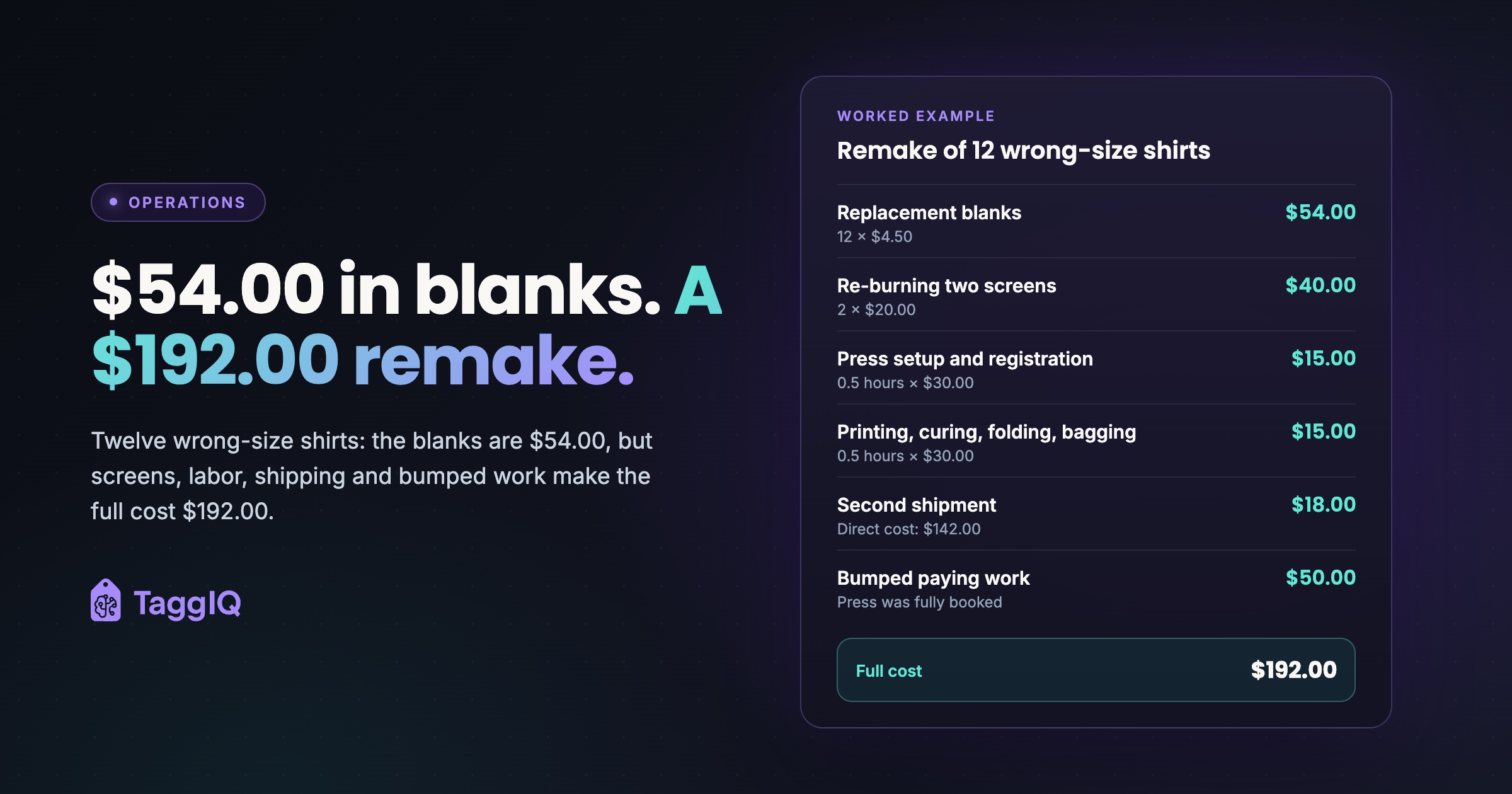
The job: 48 shirts with a two-color front print. Twelve were printed in medium when the customer ordered large, and the screens had already been reclaimed.
Replacement blanks: 12 × $4.50 = $54.00. Re-burning two screens: 2 × $20.00 = $40.00. Press setup and registration: 0.5 hours × $30.00 = $15.00. Printing, curing, folding and bagging 12 pieces: 0.5 hours × $30.00 = $15.00. Second shipment: $18.00.
Direct cost: $142.00. The press was fully booked that week, so the hour spent on the remake bumped paying work that would have contributed $50.00 (what that job pays after its materials and labor). Full cost: $192.00, against a blank invoice of $54.00.
Count bumped press time only when the press really was full. If it would have sat idle, that line is zero. And leave rent, software and other overhead out, because those bills arrive whether you remake anything or not.
Step 3: Rank causes and fix only the top one
After a quarter, group the log by cause and total the cost for each. The Lean Enterprise Institute describes a Pareto chart as a bar chart of cause frequencies with a line of cumulative percentages, used to decide which problem to work on first. A table sorted by what the shop paid, not full cost, does the same job.
Worked example
One quarter, 40 remakes, sorted by what the shop paid.
Order entry error: 14 remakes, $2,200 full cost, $2,200 shop paid, 49% cumulative share of shop paid. Artwork or proof error: 11 remakes, $1,400 full cost, $1,100 shop paid, 73% cumulative. Production error: 8 remakes, $800 full cost, $800 shop paid, 91% cumulative. Supplier or blank defect: 4 remakes, $250 full cost, $250 shop paid, 97% cumulative. Shipping damage: 2 remakes, $150 full cost, $150 shop paid, 100% cumulative. Customer changed their mind: 1 remake, $200 full cost, $0 shop paid. Total: 40 remakes, $5,000 full cost, $4,500 shop paid.
Order entry errors are 14 of the 40 remakes (35%) but 49% of what the shop paid, so they come first.
The other figure to pull from the log is the gap between Owner and Paid by: $800 the shop paid on remakes provisionally owned by a customer, supplier or carrier. That is $500 of artwork errors logged as Shop (no terms shown), plus $300 of unfiled claims for blanks ($150) and transit damage ($150).
The Lean Enterprise Institute defines 5 Whys as asking “why” repeatedly to get past the symptom to the root cause. Applied to the size remake:
- Why were twelve shirts the wrong size? The work order said medium.
- Why did it say medium? It was typed from the first email, and the customer’s later change came in on a different thread.
- Why didn’t the proof catch it? The proof showed the artwork but not the size breakdown.
The fix is one process change: the proof shows the size breakdown and quantity per color, and the customer approves both. If sizes come in from a team or club, collect them in one place first. Size collection for team apparel orders covers how. Run the log another quarter and check the order entry line has shrunk before moving on to artwork errors.
Step 4: Write your reprint policy from the log
Published reprint policies split along the same lines as your log. One university print service says that if no proof was requested and the finished piece matches the customer’s dummy (the customer’s mock-up of the finished piece), it cannot be held responsible for errors. One contract decorator publishes a 3% spoilage allowance, rising to 5% for polyester, nylon, spandex, lycra, rayon and tri-blend apparel.
Copy their structure, not their numbers. The blanks in the checklist below are placeholders you set from your own log and costs.
Not legal advice
This checklist is general guidance for US shops, not legal advice. Check your own obligations in each state where you sell, including any that apply to sales to consumers, and have a qualified local advisor review your terms before you publish them.
Reprint policy checklist for your advisor
Each item is a commercial position to discuss with a qualified local advisor, followed by the question to ask. None of it is wording to publish.
- Proof approval. Send a proof showing artwork, print or stitch locations, ink or thread colors and the size breakdown, and ask for written approval. Changes after approval are quoted as new work. Ask: can errors visible on an approved proof be charged to the customer, including consumers?
- Shop errors. If goods don’t match the approved proof, or the garment, color or quantity is wrong, reprint, credit or refund the affected pieces. Ask: can you choose the remedy, or can the customer insist on one?
- Spoiled pieces. On garments you source, replace pieces spoiled in production, or credit them at the unit price if you can’t replace them in time. Ask: can you choose replacement or credit, and what if you can’t do either by the deadline?
- Customer-supplied garments. No credit for losses up to []% per design, or []% on [list fabrics]. Above that, credit [] per piece. Request [] extra pieces per design. Ask: can you decline credit inside that allowance for goods the customer owns?
- Color. Variation within normal production tolerance, or between screen and print, is not grounds for a reprint. Ask: can you exclude it, and how should tolerance be defined?
- Quantity. Delivered quantity may vary by up to [__]%, billed for what is delivered. Ask: does this need agreeing on each order?
- Reporting window. Problems reported within [__] days of delivery, with order number, description and clear photos. Goods or a sample may be requested back. Ask: how long must the window be, and what happens to later claims?
- Customer rights and liability. Ask: what must your terms say about customer rights, and can you cap liability at the price of the affected items, or exclude indirect losses such as a missed event?
Once the wording is agreed, put the policy on the quote and on the proof, not only on a terms page. Phone approvals and email threads that do not identify the exact proof version can make it harder to establish what was approved. Artwork approvals over email explains why email threads go wrong.
Internal rules for blanks, transit damage and goodwill
Receiving. Count and inspect blanks when they arrive, before they go on the press. Check your supplier’s claim terms so you find a defect while you can still claim for it. Order a few spare blanks for your own jobs so spoiled pieces come from stock.
Transit damage. Photograph incoming cartons and note any damage on the delivery receipt. Check your carrier’s claim window and declared-value terms before you ship.
Goodwill. Set a limit, such as [__] per account per year, and log each one as Shop (goodwill), so it stays a decision rather than an expectation.
What to do this week
Start the log today with the columns above. Add the size breakdown to your proof template. Take the Step 4 checklist to your advisor, then put the agreed terms on your quotes and proofs. In 90 days, sort the log by what the shop paid and pick one cause to fix.
In TaggIQ, decoration details (print locations, colors and methods) set on the quote carry through to the order, purchase orders and artwork proofs. Proofs go to the customer by shareable link, and the approval is tracked as a task on the order. Keep the remake log itself in your spreadsheet.
See order management See how quotes, proofs and production stages connect in one order.
Frequently asked questions
How do I quote a reprint when the approved proof showed the error?
Charge only if terms your advisor has reviewed allow it and the customer's rights don't prevent it; don't rely on the approved proof alone. Then quote blanks, press time, new screens and setup at your normal rates, and log any part you waive as Shop (goodwill). Attach the approved proof and keep the note to one line: "The proof you approved on [date] shows [the error]. We can reprint the affected pieces for $[__] by [date]."
The customer approved the proof over the phone. Who pays for the remake?
Without a written record it is hard to show what was approved, and the answer depends on your terms and the circumstances. Log it as an artwork or proof error with the owner marked unresolved, and record who actually paid. Then change the process so the next approval is in writing.
How do I set the allowance for customer-supplied garments?
Treat the log as evidence for your advisor, not as authority to exclude more. If customer-supplied jobs lose more pieces than jobs on your own blanks, ask your advisor whether your terms can carry a higher allowance. You can ask for extra pieces up front now.

Dave
Dave writes for TaggIQ about running a profitable print, promo, sign and embroidery business: costing and estimating, margins, production flow, order workflows, pricing decisions and keeping customers coming back.