In this article 12 sections
- Why area and material pricing fall short
- The four cost blocks
- 1. Materials, with waste on its own line
- 2. Design time, with a revision limit
- 3. Production costed at a loaded rate
- 4. Installation from the site, not a flat add-on
- Permits: fee at cost, admin as labor
- Worked example: one storefront fascia panel
- Material-only versus four-block: the gap
- What changes the numbers
- A sign quote template you can copy
- Putting it to work this week
A customer sends a photo of their storefront and asks what an 8 by 2 foot fascia sign will cost. You know roughly what the panel costs, add something for install, and send a number that afternoon. By the time the van is back, the artwork has been through three rounds, two people have spent half a day on the job, and the profit you saw on paper is gone.
The short answer is to price every sign as four cost blocks: materials with waste on its own line, design hours with a set number of revisions, production time costed at a loaded rate and billed at a charge-out rate, and installation built from travel, crew, on-site hours and access equipment. The permit fee passes through at cost, with your admin time billed as labor. Keep per-square-foot prices for phone ballparks.
Why area and material pricing fall short
A per-square-foot rate is fast, and speed is what it’s for. Use it for a quick ballpark budget over the phone, and build the real quote from the actual costs of the job.
The trouble is that design, travel and install time do not grow with a sign’s area. The van, the crew and the ladders go out either way. A price built on finished area or material cost quietly treats those hours as free. That is the same kind of leak covered in the hidden costs that quietly destroy print shop margins.
The four cost blocks
1. Materials, with waste on its own line
Itemize by category: substrate, print media, ink, laminate, mounting hardware and, where relevant, electrical. Each one has its own price and its own waste pattern, so lumping them together hides where the money leaks.
Then show waste as its own line instead of burying it. Offcuts, nesting losses, test prints and the occasional misprint are all material you paid for. Price from the material you use, not from the finished size.
Set a markup for each category rather than one blanket figure, and let small jobs carry a higher markup, because handling and admin cost the same whatever the size. Put subcontracted electrical or fabrication work on separate lines, each with its own markup.
2. Design time, with a revision limit
Bill design at its own rate, which can sit above production because it draws on different skills. Quote it in hours, say how many revision rounds are included, and say what extra rounds cost. The guide to artwork approvals covers how to stop those rounds from drifting.
3. Production costed at a loaded rate
Price printing, laminating, mounting, cutting, cleaning and packing in hours. The rate matters more than the hours, and it helps to keep two rates apart. Your loaded cost is what an hour actually costs you: wage, benefits and payroll costs, plus a share of overhead. Your charge-out rate is what you bill the customer, which is loaded cost plus profit.
Benefits alone are a big share of that cost. The U.S. Bureau of Labor Statistics reports that in June 2026, private industry employer compensation averaged $46.89 per hour worked. Of that, $32.82 (70.0%) was wages and salaries and $14.07 (30.0%) was benefits. That works out to about 43 cents in benefits for every dollar of wages. It is a national average across all private industry, not a sign-shop figure, so check your own payroll.
Worked example: building a loaded rate
Start with an illustrative wage of $22.00 an hour. Benefits and payroll costs at about 43% add $9.50. Overhead (rent, equipment, software, insurance, admin) is $8,400 a month spread over 300 billable hours across the team, which adds $28.00 an hour. That gives a loaded cost of $59.50 an hour. Add about 26% for profit and the production charge-out rate becomes $75.00 an hour. Overhead is already inside the loaded cost, so it never appears again as a separate line on the quote.
4. Installation from the site, not a flat add-on
Build the install price from the site, using these lines:
- Travel time both ways, for every person in the van
- Crew size times on-site hours
- Access equipment: ladders, scaffold tower, lift or bucket truck
- Vehicle cost per trip
- Site conditions: brick or stucco, height, sidewalk traffic, parking
Mounting hardware belongs in materials, so don’t count it again here. For permanent exterior signs, survey the site before you quote, either with a visit or with good customer photos and measurements. If a visit is needed, charge it as a survey fee or credit it against the job if you win it, so the survey doesn’t become another unpaid hour.
Permits: fee at cost, admin as labor
Before any exterior job, check whether your city requires a permit for the sign, whether an illuminated sign needs a separate electrical permit, who is responsible for applying, how the fee is calculated, and whether the landlord or property manager must approve the sign. Ask your local permitting office what approvals and timing apply to your job before scheduling installation.
Quote the fee at cost and add your admin time for the application. This is general guidance, not regulatory advice, so check your own city’s requirements and your own obligations before every exterior job.
Worked example: one storefront fascia panel
Worked example: 8 ft x 2 ft fascia, the job
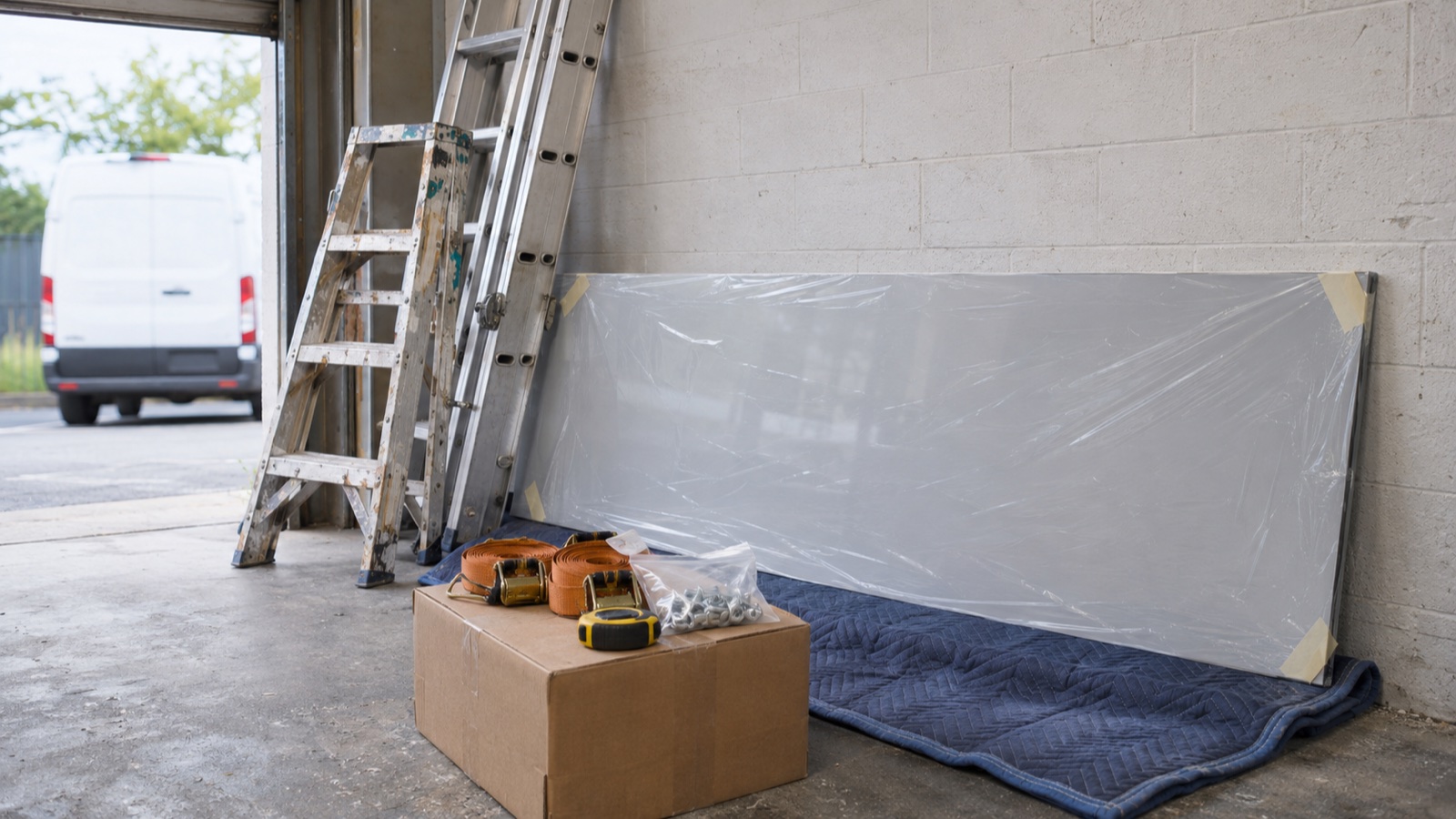
The job is an 8 ft x 2 ft fascia (16 sq ft finished) on 3 mm aluminum composite panel (ACM) with printed, laminated vinyl. It is not illuminated and mounts to brick about 10 ft up. Customer photos and measurements replaced a site visit, so there is no survey charge, and they confirm two ladders are enough. Material costs, markups, rates and the permit fee are illustrative, and every hour is costed at the illustrative loaded cost of $59.50 from the example above. The permit fee is an illustrative $85.00; real fees vary by city.
Worked example: materials block
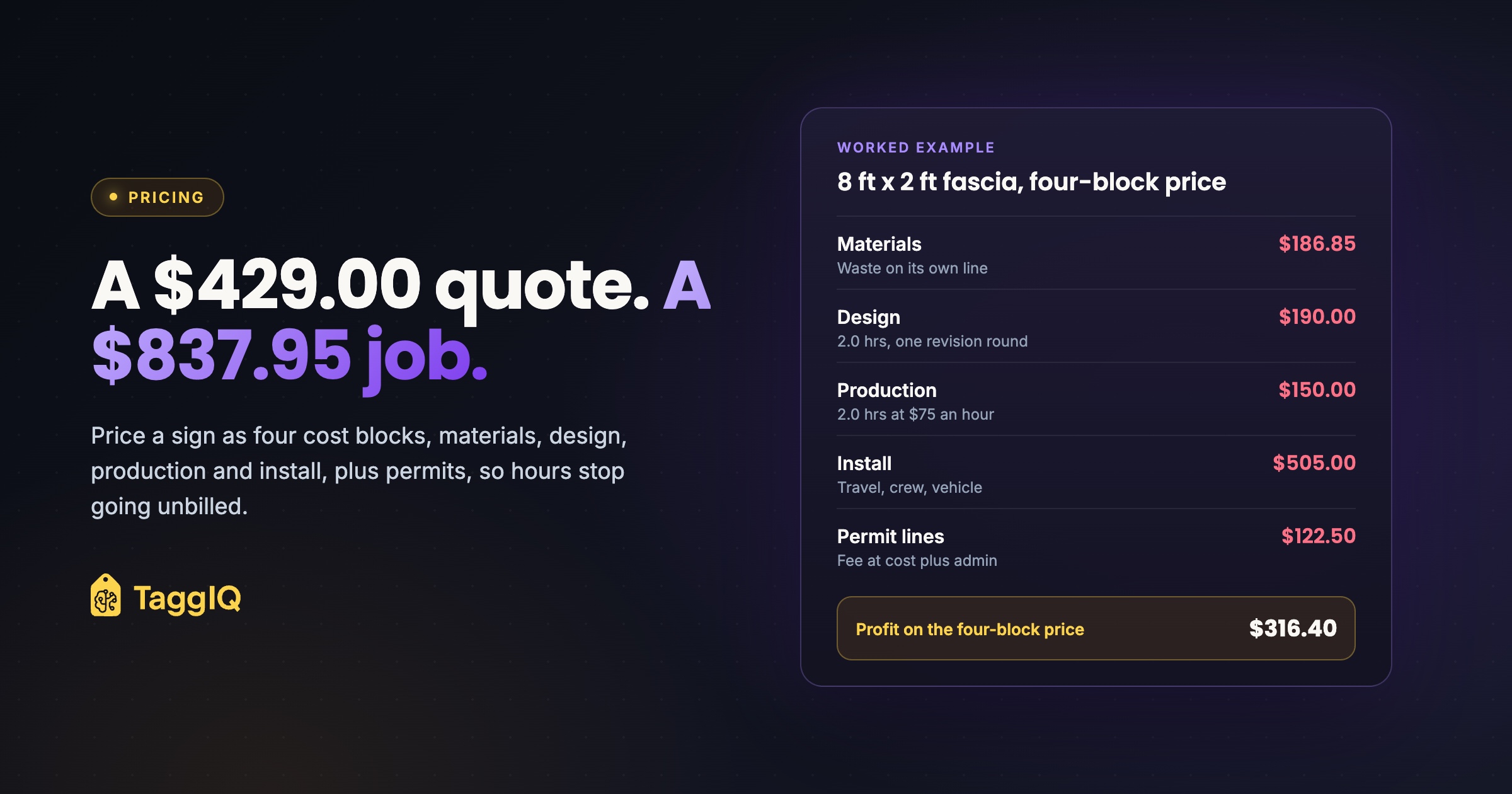
Panel stock (ACM, print media, ink and laminate) for the 16 sq ft finished area, at an illustrative $4.25 per sq ft, costs $68.00 and sells at $119.00 with a 1.75x markup.
Waste allowance of 15% adds 2.4 sq ft at $4.25, which costs $10.20 and sells at $17.85 at the same 1.75x markup.
Mounting hardware and sealant, one set, cost $25.00 and sell at $50.00 at 2x, a deliberately conservative illustrative markup.
Materials block: $103.20 cost, $186.85 sell.
Worked example: design and production blocks
Design is 1.5 hours of artwork plus 0.5 hours for one revision round. The 2.0 hours cost $119.00 and sell at $190.00 at a $95 design charge-out rate.
Production covers print, laminate, mount, trim and pack. The 2.0 hours cost $119.00 and sell at $150.00 at the $75 production charge-out rate.
Design and production together: $238.00 cost, $340.00 sell.
Worked example: install and permit blocks
Travel is a 1 hour round trip for 2 crew, so 2 crew-hours. They cost $119.00 and sell at $160.00 at an $80 install charge-out rate. The install rate sits above production to cover site insurance and the risk of delays on site.
On site is 2 hours for 2 crew, so 4 crew-hours. They cost $238.00 and sell at $320.00 at $80 an hour.
The vehicle is one trip at $25.00, passed through at $25.00. Ladders are already owned, so access equipment is $0.00.
Install block: $382.00 cost, $505.00 sell.
The permit fee is $85.00 at cost. Permit admin is 0.5 hours, costing $29.75 and selling at $37.50 at $75 an hour. Permit lines: $114.75 cost, $122.50 sell.
Worked example: profit on the four-block price
Adding the blocks gives a delivery cost of $837.95 ($103.20 + $238.00 + $382.00 + $114.75) and a price of $1,154.35 ($186.85 + $340.00 + $505.00 + $122.50). The quote leaves $316.40 of profit, which is 27.4% of the price. Extra revision rounds are billed at $95 an hour.
Material-only versus four-block: the gap
Worked example: the shortcut quote
The shortcut prices materials on finished area only (16 sq ft at $4.25 is $68.00, plus $25.00 of mounting hardware, so $93.00), multiplies by three to get $279.00, and adds a flat $150.00 for install. That makes $429.00.
The job still costs $837.95 to deliver, so the shortcut loses $408.95. The bigger gap is not the $10.20 of waste. It is the 10.5 paid hours (design, production, install and permit admin), which cost $624.75 at $59.50 before a single sheet is bought.
The four-block price works out to $72.15 per sq ft. Install and permit together come to $627.50, more than half the price, and they would barely change if the panel were 24 sq ft. A per-square-foot rate taken from big jobs will tend to underprice small ones.
What changes the numbers
Each block moves on its own, which is the main reason to keep them separate. When a customer pushes back, you can see which line to adjust instead of cutting the whole price.
Worked example: three common changes
If the survey shows the fascia sits 18 ft up over a sloped sidewalk, add an illustrative half-day lift hire of $175.00 and an extra half hour on site for two crew, so 1 crew-hour at $80.00. The price rises by $255.00 to $1,409.35.
If the customer orders a matching panel for a side wall, design and travel don’t repeat. Materials and production do, and on-site time grows.
If the sign is illuminated, add a subcontracted electrical line with its own markup and allow for any electrical permit as well as the sign permit.
For the side-wall or illuminated sign, rerun the materials, production and on-site rows in the template below rather than scaling the original price.
Small jobs need one more protection: a minimum charge that keeps small jobs paying. Base it on the fixed hours of setup, file prep, quoting and invoicing at your charge-out rate, plus your smallest material buy.
A sign quote template you can copy
For every labor row, put your loaded cost under unit cost and bill at your charge-out rate.
| Block | Line | Quantity | Unit cost | Markup or charge-out rate | Sell | Note |
|---|---|---|---|---|---|---|
| Materials | Substrate | sq ft used | Markup | |||
| Materials | Print media | sq ft used | Markup | Include ink | ||
| Materials | Laminate | sq ft used | Markup | |||
| Materials | Waste allowance | sq ft | Markup | Waste = the greater of (finished area x waste %) or (sheet or roll area used minus finished area). Charge the full offcut if it can’t be reused | ||
| Materials | Mounting hardware | Markup | Not repeated under install | |||
| Materials | Subcontracted items | Own markup | Electrical, fabrication | |||
| Design | Artwork hours | hours | Loaded cost | Design charge-out rate | Revision rounds included: | |
| Design | Extra revision rounds | hours | Loaded cost | Design charge-out rate | Billed only if used | |
| Production | Print, laminate, mount, cut, pack | hours | Loaded cost | Charge-out rate | ||
| Install | Site survey | visit or photos | Loaded cost | Charge-out rate or fee | Credit against the job if won | |
| Install | Travel | crew x hours | Loaded cost | Install charge-out rate | Both directions | |
| Install | On site | crew x hours | Loaded cost | Install charge-out rate | From site survey | |
| Install | Access equipment | Ladder, tower, lift | ||||
| Install | Vehicle | trips | ||||
| Permits | Fee | At cost | Check local schedule | |||
| Permits | Admin | hours | Loaded cost | Charge-out rate | ||
| Tax | Sales or use tax (if applicable) | Check how your state treats supplied versus installed signs | ||||
| Minimum | Minimum charge | Fixed hours x charge-out rate + smallest material buy; applies below: |
Putting it to work this week
Re-cost your last three exterior sign jobs with this template and compare the result with what you charged. Find the block where the gap is largest, and fix that line first. Then work out your loaded cost and charge-out rate from your own payroll and overhead, add a revision clause to your quote wording, and make a site survey a step before any install price goes out.
If you’re curious where AI might fit into sign quoting, TaggIQ has written up an illustrative sign shop AI quoting scenario. It is a hypothetical walkthrough of proposed tools, not a real customer’s results.
If you’d rather not rebuild this in a spreadsheet each time, TaggIQ’s AI Co-Worker drafts a structured sign quote covering materials, finishing and install from a plain-English job description, and your team reviews it before it goes out. Proof links and revision tracking keep the design rounds and the customer’s sign-off on the job record before anything is cut or printed.
See TaggIQ for sign shops See how TaggIQ handles sign quotes, proofs and production in one workflow.
Frequently asked questions
Should I stop giving per-square-foot prices over the phone?
No. A ballpark helps a customer decide whether to keep talking. Give it as a range, say clearly that it excludes install and permits, and follow up with the line-item quote once you have measurements and site photos. Base the range on your own past four-block quotes for similar jobs so it reflects what work actually costs you.
How many revision rounds should I include?
Tie the number to the design hours you quoted. If you quote two hours, one round is realistic. State the number on both the quote and the proof, so that when a customer asks for a fourth version, the conversation is about an agreed charge and not a favor.
What if the customer wants to install the sign themselves?
Drop the install block, but add a line for packing or crating, and note on the quote that mounting hardware and site conditions are the customer's responsibility. Run the permit checks above to confirm who applies for the permit when you only supply the sign.

Dave
Dave writes for TaggIQ about running a profitable print, promo, sign and embroidery business: costing and estimating, margins, production flow, order workflows, pricing decisions and keeping customers coming back.