In this article 12 sections
- What a polite no really costs
- Promo is a different business, not another product line
- Where the margin really comes from
- The charges that go missing from promo quotes
- The cash gap nobody quotes for
- Product safety duties come with resale
- The ten-question readiness test
- The first three changes to make
- 1. A promo quote template that lists every charge
- 2. One purchase order per supplier, per job
- 3. Written proof sign-off and a traceability record
- Your next step this week
A customer collects their exhibition banners and leaflets, then asks whether you can also do 250 branded mugs and some tote bags for the same show. You either say no and watch that spend go elsewhere, or you find a supplier in a hurry, guess a price and hope the mugs arrive before the doors open.
The short answer: add promotional products if your customers already ask for them and you can handle what comes with them. Promo is a different business model from print. You earn a resale margin on goods someone else makes, and you take on supplier admin, hidden charges and a cash gap. Score your shop on the ten questions below, then make three changes before you quote your next serious promo job.
What a polite no really costs
When you turn down a promo request, you risk more than one order. If the customer buys the mugs elsewhere, that seller now has a reason to talk to them about banners, leaflets and uniforms as well.

Promo is a different business, not another product line
A promo distributor sources branded merchandise from suppliers and sells it to businesses, teams, events and organisations, while owning the customer relationship.
| Factor | In-house print or decoration | Bought-in promo |
|---|---|---|
| Where the margin comes from | Materials, machine time and labour you control | Your markup on supplier prices and charges |
| What limits volume | Press, machine and staff capacity | Quoting and admin time |
| How the price is set | From your own costs | From supplier trade pricing plus your markup |
| Main risk | Spoilage and reprints in your workshop | Missed charges, stock changes, late or wrong supplier work |
| Admin per job | Blank order and one job ticket, mostly with suppliers you already use | Stock check, purchase order, supplier proof and delivery tracking for each supplier |
| Cash timing | Stock and consumables bought ahead | A new trade account may want paying before dispatch; the customer pays later |
If you already decorate, you will run two routes side by side: items decorated on your own kit, such as apparel, and items bought in already decorated.
Where the margin really comes from
Worked example: two 250-unit jobs
In-house T-shirts. 250 tees with a one-colour front print. Blanks at £2.80 each cost £700. Screens, ink and consumables add £90, and five hours of press and finishing labour at £15 an hour adds £75. Direct cost is £865. Sold at £7.50 each, the job brings in £1,875, a gross profit of £1,010 (53.9%).
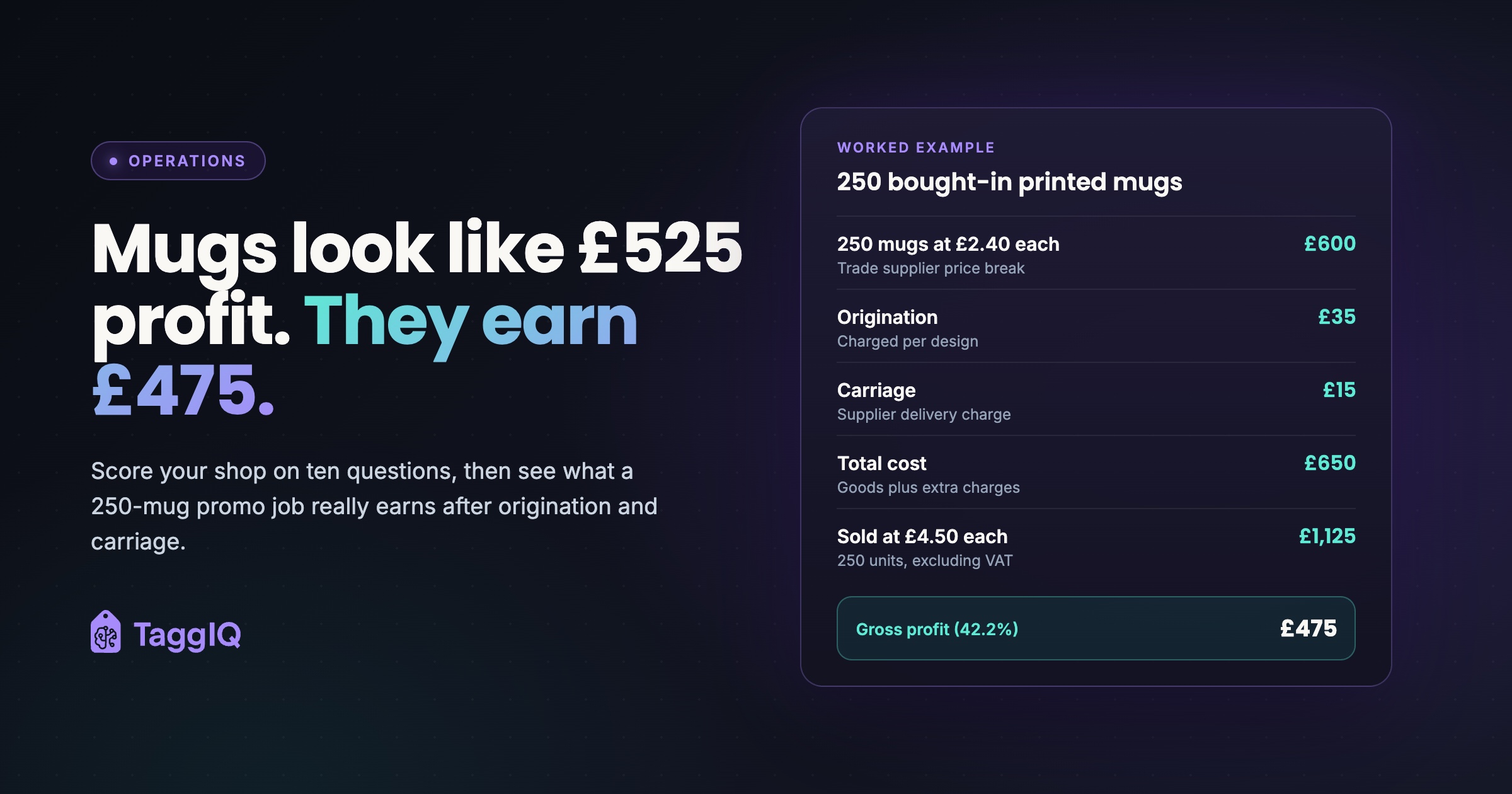
Bought-in mugs. 250 printed mugs from a trade supplier at £2.40 each at that price break cost £600. Origination is £35 and carriage £15, so total cost is £650. Sold at £4.50 each, the job brings in £1,125, a gross profit of £475 (42.2%). It uses no press time, but around 75 minutes of admin: quote, stock check, purchase order, proof approval and delivery chasing.
Price the mugs on unit cost alone and you would expect £525 of profit. The £50 of extra charges comes off before anything goes wrong.
All figures are illustrative and exclude VAT. Neither gross profit includes rent, software or your own pay. Those are overhead, paid from the gross profit of every job.
The mugs add revenue without new equipment, but every pound depends on the quote catching every charge.
Worked example: the same mugs at 50 units
At 50 mugs the supplier’s unit price is £3.10 at the lower break, so the goods cost £155. The same £35 origination and £15 carriage bring total cost to £205. Quoted at £6.00 each, the job brings in £300, a gross profit of £95 (31.7%). If the admin still takes an hour, that is £95 of gross profit per admin hour, against £380 per admin hour on the 250-mug job (£475 over 75 minutes). At a £150 gross profit floor per job, this quote would need a £55 handling line.
Set a rule for small orders before the next one arrives. Choose a minimum gross profit per promo job that covers your admin time. Below it, add a visible handling line or decline politely, and write the threshold into your quote template. Setting minimum order quantities so small jobs still pay shows how to choose the number.
The charges that go missing from promo quotes
- Origination or setup, charged per design and sometimes per position.
- Extra decoration positions or colours, priced separately from the unit price.
- Artwork preparation, when a customer’s logo needs redrawing as vector artwork before a supplier will accept it.
- Carriage, including split deliveries to more than one address.
- Samples and pre-production proofs, when the customer wants to see one first.
- Price breaks and stock on the day. Check the live price at your quantity and whether the stock exists, not last month’s list.
The cash gap nobody quotes for
Promo can mean paying a supplier for a whole order before the customer has paid you anything.
Worked example: paying out before you get paid
The customer approves the mug order on day 0, and you pay the supplier £650 on order. Production and delivery take 14 days. The customer is on 30-day terms from delivery and pays on day 44. You have funded £650 for 44 days. Now picture a conference pack order with £5,000 of supplier cost on the same timeline. Two of those in one month could put up to £10,000 of your cash with suppliers at once, each for over six weeks.
That makes payment terms a margin decision. From new customers, take a deposit that at least covers the supplier cost, or take full payment upfront. For trusted accounts, agree terms that line up with what your supplier asks of you.
Product safety duties come with resale
Reselling goods you did not make still carries legal duties. The Office for Product Safety and Standards’ statutory guidance for Great Britain treats a distributor as anyone in the supply chain whose activity does not affect a product’s safety properties. It says distributors must act with due care to help ensure only safe products are supplied, must not supply products they know or ought to know to be dangerous, and must cooperate with enforcement authorities. It adds that they should pass on risk information and should be able to show who supplied the goods. Anyone who presents themself as the manufacturer by putting their own name or trade mark on a product is treated as a producer.
Northern Ireland follows different product safety rules from Great Britain: the same GOV.UK guidance notes that the 2005 Regulations were superseded there on 13 December 2024 by EU Regulation 2023/988.
This is general guidance, not legal advice. Check your own obligations with Trading Standards or a qualified adviser, particularly if you decorate items yourself, repack items, assemble kits, put your own name on products or supply customers in Northern Ireland.
The ten-question readiness test
Answer each question from your own records. Give one point for every yes.
| # | Question | Check it against |
|---|---|---|
| 1 | Have at least five existing customers asked for promo items in the last 12 months? | Inbox, enquiry log, counter notes |
| 2 | Do those requests cluster around a few product types, such as drinkware, bags, pens or notebooks? | The same enquiries, grouped by product |
| 3 | Do your recorded enquiries show enough jobs above your gross profit floor? | Enquiry details and your sales ledger |
| 4 | Do you hold, or could you open, trade accounts with at least two suppliers for those products? | Supplier accounts and applications |
| 5 | Can you build a quote that shows every charge, from price break to carriage, without guessing? | One test quote for a real past enquiry |
| 6 | Do you know how many minutes a quote takes you today? | Time your next five quotes |
| 7 | Do you raise a written purchase order for everything you buy in? | Your last month of supplier orders |
| 8 | Do you get written customer sign-off on every proof before production? | Your last ten approved jobs |
| 9 | Could you fund the supplier cost of your largest likely order for 45 days if the customer paid no deposit? | Payment terms and bank balance |
| 10 | Could you show who supplied any item and who bought it, years after the sale? | Where your order records live today |
Then apply the decision rule:
- 8 to 10: start now. Launch a short range built around the product types from question 2.
- 5 to 7: run a curated pilot. Fix every no before you launch, then offer that short range to existing customers only for three months.
- 0 to 4, or a no on question 1: not yet. Keep logging every promo request and take the test again in six months.
The score bands are a suggested starting rule, not an industry benchmark, so move them if your margins or cash call for it.
The first three changes to make
1. A promo quote template that lists every charge
Give every quote a line for the unit price at the confirmed break, origination, each decoration position, carriage and samples, plus your markup. If a line is zero, show the zero, so you know someone checked it. Add two fields for your own use: minutes spent on the quote and whether it won. After three months, those fields tell you whether promo pays for the time it takes. TaggIQ’s free quote template and purchase order template give you a starting point.
2. One purchase order per supplier, per job
Raise a written purchase order to each supplier on a job, with product, quantity, decoration, agreed price and the delivery date you need. Confirm the supplier’s production lead time and delivery before you confirm an event date to your customer, then track each supplier order separately until it arrives. When goods arrive, check the count and the decoration against the approved proof before they go out, and ask suppliers delivering straight to your customer to ship unbranded or under your name. Purchase orders for promo shops covers what to put on one.
3. Written proof sign-off and a traceability record
When the supplier sends a proof, forward it to the customer and get their written approval before you approve production. Then record which supplier made each item and which customer received it, somewhere you can still find it years later. For Great Britain, the OPSS guidance says distributors should retain documentation showing who supplied the goods. Check the retention periods and any additional traceability duties that apply to your products and business.
Your next step this week
Go through your inbox and enquiry records for the last 12 months and count every promo request, including the ones you turned down on the phone. Group them by product, then score the ten questions. If the result says start, take your top three or four product types from that count, open trade accounts, using a supplier comparison checklist to weigh price breaks, setup charges, delivery deadlines and payment terms, and build your quote template before you promise anything. Once the first orders run cleanly, look at repeat work such as staff uniforms, event packs and branded stores. That is where promo turns from one-off quotes into recurring revenue.
TaggIQ’s promo distributor software runs a promo job from quote to order to purchase order to invoice in one place, with supplier catalogue search.
See promo distributor software See whether it fits the way you want to run promo.
Frequently asked questions
Do I need new equipment to sell promotional products?
No. Bought-in items arrive decorated by the supplier, so you need no extra kit. If one product type starts selling in volume, compare the supplier's decorated price with your own cost of decorating it in-house, including machine time and labour, before you buy anything.
What happens if the supplier delivers late for my customer's event?
Your customer bought from you, so the problem is yours to handle. Confirm production lead time and delivery in writing before you accept the date, leave a buffer before the event, and state in your quote that the delivery date depends on proof approval by a set day.

Dave
Dave writes for TaggIQ about running a profitable print, promo, sign and embroidery business: costing and estimating, margins, production flow, order workflows, pricing decisions and keeping customers coming back.