In this article 10 sections
- The five decisions at a glance
- 1. Store type: checkout or enquiry
- 2. Catalogue: only what you can source and price
- 3. Pricing: make the price carry the store
- 4. Payment: who pays, and when
- 5. Closing date: count back from the hand-out
- UK points to check before launch
- Agree the roles in writing
- Where TaggIQ webstores fit the five decisions
- Webstore launch checklist
A company, club or school asks for kit for everyone, and a week later you are holding a spreadsheet of half-filled sizes, bank transfers with no reference and one request for a colour nobody else wants. A corporate or team webstore fixes that, but only if the business decisions are made before anyone builds it.
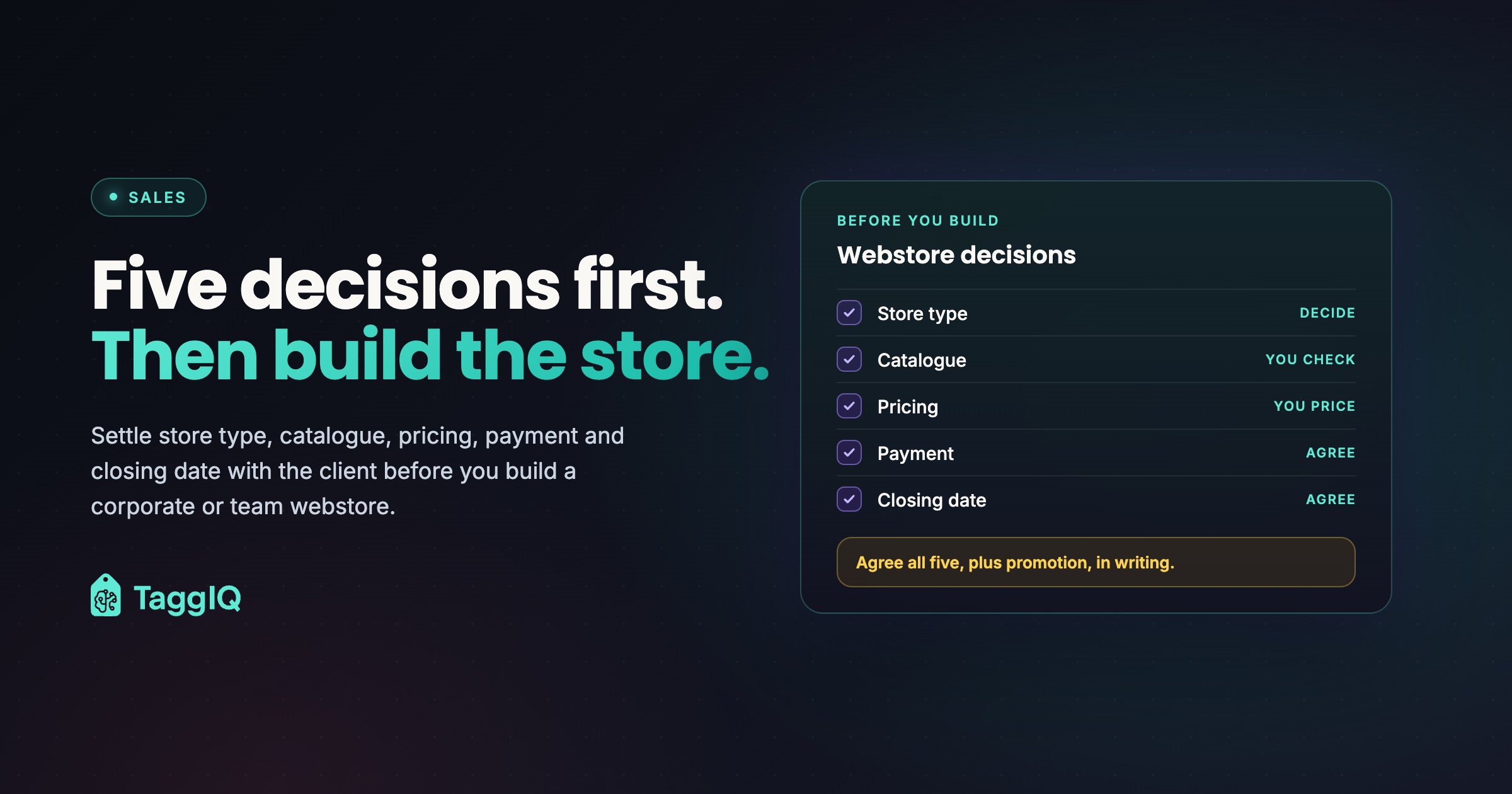
The short answer: settle five things with the client first (store type, catalogue, pricing, payment and closing date) and agree them in writing. That turns dozens of separate size, payment and artwork conversations into one consolidated production run.
The five decisions at a glance
| Decision | The question to answer | What goes wrong if you skip it |
|---|---|---|
| Store type | Fixed-price checkout, or enquiry and quote? | Bespoke work forced into a fixed price, or simple reorders stuck in quote loops |
| Catalogue | Which garments, colours, sizes and placements? | Out-of-stock variants and unpriced surcharges at close |
| Pricing | Does the price carry card fees, uplifts, packing and delivery? | A busy store that quietly loses margin |
| Payment | Who pays, and when is the money taken? | Producing kit for people who never pay |
| Closing date | When does it close, counted back from what date? | Production squeezed into whatever time is left |
1. Store type: checkout or enquiry
A fixed-price checkout suits anything with a known price: a crested training top, a polo with a left-chest logo, a branded bag. An enquiry route suits anything that varies, such as signage or a one-off presentation piece.
The rule: if you cannot price it on the product page today without the word “from”, it belongs behind an enquiry form.
2. Catalogue: only what you can source and price
Keep the range short and signed off by the client against mock-ups: a few garments, limited colours, only the sizes you can actually get, and fixed decoration placements.
Before opening, check stock for every colour and size you will show, and remove anything you cannot buy at the cost your price assumes. For high-volume lines, reserve stock early or agree a substitution and refund rule with the client, shown at checkout. Publish measurements for each size, and if you offer names or numbers, read the personalised-goods point below before you write your returns wording.
3. Pricing: make the price carry the store
A store price has to carry costs a quoted job may not: a card fee on every transaction, extended-size uplifts, individual bagging and delivery.
Worked example: pricing an adult training top
All figures are illustrative. Blank £8.50, decoration £3.00 and individual bagging £0.40 make £11.90 per top. The target is a 35% margin on the price before VAT, the top is assumed to be standard-rated at 20%, and the card fee is an illustrative 1.5% + 20p on a single-item order (use your own processor’s rates). Delivery is left out; if you offer free bulk delivery, add its cost per top before setting the price.
Priced the quick way (blank plus decoration, priced for a 35% margin before VAT, ignoring bagging and card fees), the top is £11.50 ÷ 0.65 × 1.20, which is £21.23, rounded to £21.25, or £17.71 before VAT. Take off blank and decoration (£11.50), bagging (£0.40) and the card fee (£0.52) and the margin is £5.29, or 29.9%.
Priced with everything in, £22.99 is £19.16 before VAT. The card fee is £0.54, so the margin is £19.16 minus £11.90 minus £0.54, which is £6.72, or 35.1%. At an illustrative premium-card rate of 2.8% + 20p, the fee rises to £0.84 and the margin falls to 33.5%.
The £2.00 uplift on 3XL and above needs about £3.80 on the selling price to hold that margin, because it also carries VAT and the card percentage. Rounded up, 3XL and above sell at £26.99.
The £3.00 decoration figure includes £1.50 of screen set-up, which assumes £60 of set-up spread over at least 40 tops of the same design. If only 9 order, set-up is £6.67 a top, and the extra £5.17 cuts the margin from £6.72 to £1.55.
If a club takes a commission per item, agree it before pricing. In the standard-rated example above, gross it up for VAT and the card percentage the same way as the 3XL uplift; check the VAT treatment of the arrangement first.
Set a minimum per design. Divide each design’s set-up cost (screens, digitising) by the set-up per item your price assumes: that is the number of orders the run needs to pay. Agree in writing what happens if the store closes below it: the client pays the shortfall, you switch to a method with little set-up per item, such as transfers, or everyone is refunded. Show the minimum and the below-minimum outcome on the product page. Setting minimum order quantities so small jobs still pay covers how to pick the numbers.
Delivery is the other pricing call: build it into the item price or offer it as a clear option. Any charge every buyer must pay belongs in the price from the first screen; see the UK points below.
Your time setting up and running the store is overhead, not a per-item cost. If the margin will not cover it, put a set-up fee in the client agreement rather than adding it at checkout.
4. Payment: who pays, and when
| Model | How it works | Agree up front |
|---|---|---|
| Individual pays | Each person pays by card at checkout | Consumer pricing and cancellation rules (see below) |
| Company pays | Staff choose within an allowance or approved list; the company is invoiced | The allowance, the approved items and who signs off |
| Mixed | Company funds a starter pack; people buy extras themselves | How the two routes are kept separate in your records |
Avoid holding cards now and charging when the store closes. Stripe’s documentation says an online card authorisation is usually valid for 7 days, and about 5 for Visa merchant-initiated authorisations. For individual payers, checkout payment means the money is in before you order their blanks.
5. Closing date: count back from the hand-out
Start from the date the client needs the goods. Count back through delivery, production (including blank lead time and packing) and a buffer. The closing date is what is left, and once agreed it does not move.
Worked example: a closing date counted back
Illustrative dates for a youth football club with 60 players and 15 coaches, handing out kit at training on Saturday 6 March 2027.
- Kit at the club by Wednesday 3 March, leaving Thursday and Friday as a buffer.
- Delivery takes 3 working days, so dispatch by Friday 26 February.
- Production takes 10 working days, covering blanks, decoration and bagging, so it starts Monday 15 February.
- The store closes at 23:59 on Sunday 14 February.
- It is open for 14 days, so it opens on Monday 1 February.
Worked example: planning for late orders
Illustrative figures. A 120-person company funds two items each, with paid extras on top. If 70% order before close, that is 84 people and 168 funded items in the main run. If a further 10% ask after close, that is 12 people and 24 items: a second production run with its own set-up.
Decide before launch whether late orders wait for the next reopening, go into a top-up batch on a fixed date priced to cover its set-up, or are paid for at extra cost by the company.
UK points to check before launch
Your buyers may be consumers. When staff, parents or players pay with their own card, treat them as consumers until you have checked otherwise. The CMA’s price transparency guidance (CMA209) says prices should include charges the consumer will necessarily incur, and describes adding mandatory charges later in the purchase process (drip pricing) as prohibited.
Personalised goods. Treat a shirt with a name and number separately from a stock-size crested hoodie, and check the consumer cancellation rules that apply to each product before you write your returns wording.
School stores in England. DfE statutory guidance says that since September 2026 schools must limit compulsory branded uniform and PE kit items to 3 or fewer, or 4 for secondary and middle schools where one is a tie. Optional items do not count. Schools should avoid single-supplier contracts unless they run regular tendering competitions that secure best value for money, and re-tender at least every 5 years, so plan around optional ranges and retendering dates, and check the school’s arrangements.
VAT on school sweatshirts. HMRC’s VAT Clothing manual says school sweatshirts can be zero-rated regardless of size if they are sold only to pupils of a school where all pupils are under 14, carry a prominent identifying logo, and are not sold to staff or PTA members. A store that also sells to staff, or mixes adult and junior sizes, should check the VAT treatment of each line before pricing.
Collect only what the order needs. For a junior club store, that might be a name for the bag label, a size and a parent’s contact, depending on the order’s purpose. Check your data protection obligations before adding any other field.
This is general guidance, not legal or tax advice. Check the official guidance or an adviser before you launch.
Agree the roles in writing
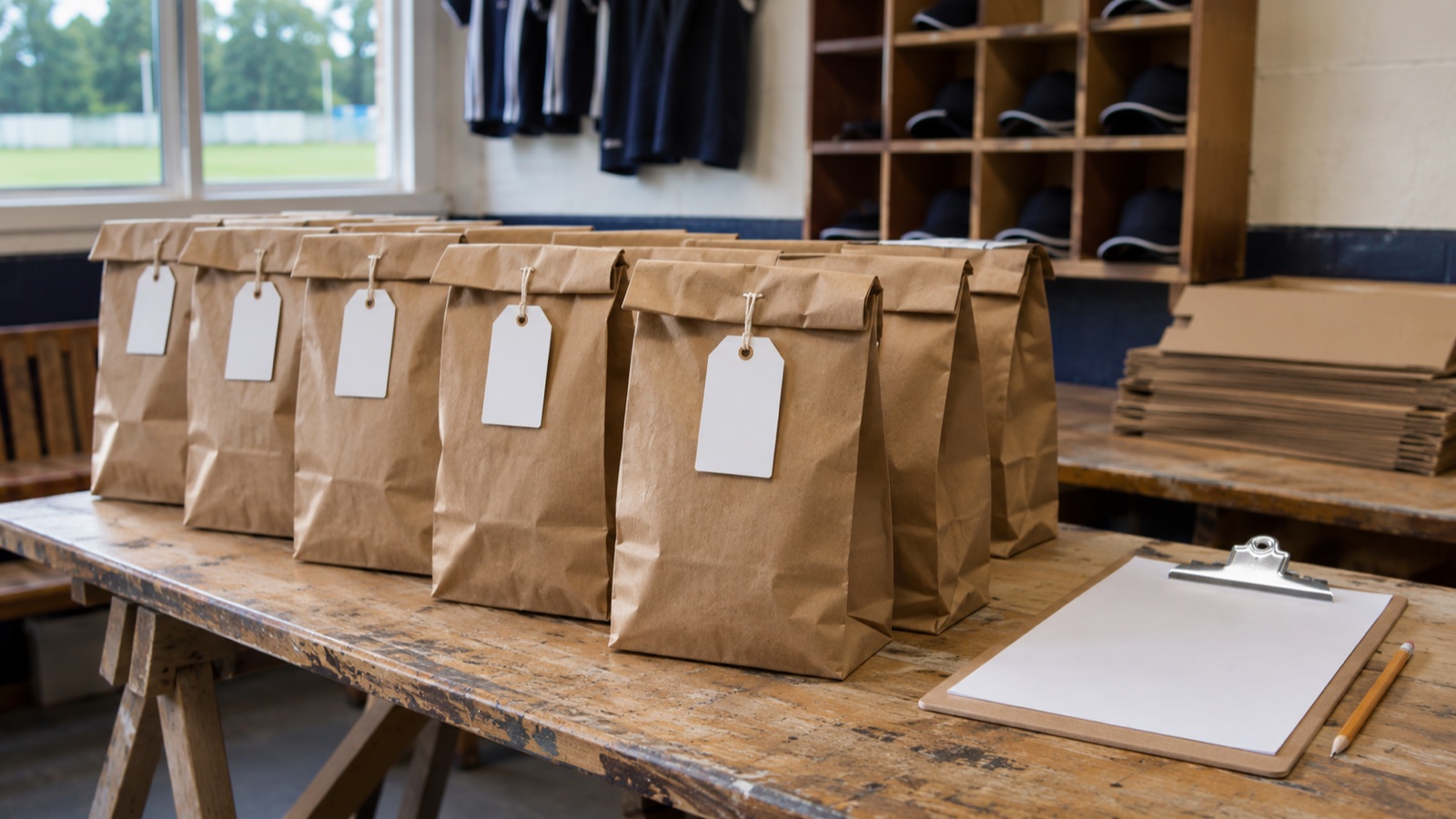
A store only stops the chasing if someone owns each loose end. Agree in writing who promotes the store, who chases people who have not ordered, whether goods go in bulk to one contact as individually labelled packs or to each buyer’s home, and what happens to orders after close.
Where TaggIQ webstores fit the five decisions
In TaggIQ, an Ecommerce store gives fixed-price products a cart and Stripe checkout, and a Catalogue store (TaggIQ’s enquiry-type store) takes enquiries and quote requests that appear as leads on your sales pipeline board. Payments go through Stripe Connect directly to your account. For each store, you can show only the colour and size variants you chose and set custom prices or a markup percentage. Orders sync to your pipeline tagged with “Webstore” as the source, and buyers get automatic confirmation and shipping emails.
Company stores and custom setups are listed as coming soon on the TaggIQ webstores page. Until then, invoice company-funded allowances separately, and put your closing date in the store’s announcement bar. For team orders that do not need a store, see the size collection guide.
Webstore launch checklist
- Hand-out date agreed with the client, plus a buffer, and the closing date counted back and written into the agreement.
- Store type chosen: checkout for fixed prices, enquiry for anything that varies.
- Catalogue signed off against mock-ups, with stock checked for every variant shown.
- Prices worked out with card fees, size uplifts, any commission, bagging, delivery and VAT, and any mandatory charge shown from the start.
- Payment model agreed: individual payers pay at checkout, and company-funded items are invoiced as agreed.
- Minimum orders per design set and shown on the product page, with the below-minimum and late-order rules written down.
- Promotion, chasing and distribution responsibilities assigned.
- Returns wording checked against the consumer cancellation rules for each product, with size measurements published.
- Checkout fields limited to what the order needs and checked against your own obligations.
- School stores checked against branded-item limits, supplier arrangements and VAT conditions.
- Catalogue, artwork and pricing worksheet saved for the next reopening.
See TaggIQ webstores See how TaggIQ webstores handle checkout, enquiries and per-store pricing for your next club or staff store.
Frequently asked questions
Should I offer home delivery or bulk delivery to the club?
Bulk delivery to one contact means one parcel, but every pack needs a clear name label and the client needs someone to hand them out. Home delivery suits staff spread across sites, and it costs per parcel, so offer it as a priced option with bulk as the default.
Can I reopen the same store next season?
Yes, and plan for it at launch. Keep the approved catalogue, artwork and pricing worksheet together, so reopening means rechecking stock and costs rather than starting again.
What if someone orders the wrong size?
Decide your exchange policy before launch and show it at checkout, separately for personalised and unpersonalised items.

Emma
Emma writes for TaggIQ about practical AI and automation for print, promo, sign and embroidery businesses: AI assistants and agents, quoting and follow-up workflows, customer experience and keeping people in charge of the decisions that matter.