In this article 8 sections
- Why handing over tasks is not enough
- Step one: run a ten-day decision census
- Step two: sort each decision into the delegation map
- Step three: write three pricing rules
- Step four: record the reason on the job
- Step five: stop overriding, then test it
- Where software fits, and where it does not
- Your next step this week
A quote for 50 embroidered polos sits in the queue because you are on a site visit. A proof waits for your nod. Someone at the counter asks for a rush job, and the answer is “I’ll check with the boss”. By the time you get back, the customer has gone elsewhere.
The short answer: to delegate decisions, not just tasks, give each one a written limit. Map every decision that comes to you, sort it by how easy it is to undo, and give the reversible ones to named people with a number attached. You keep the few decisions that cannot be undone.
Why handing over tasks is not enough
Plenty of owners have already delegated the work. Staff build the quote, check the artwork and talk to the customer. But the decision still sits with the owner, so every job ends with the same question: “Is this OK?”
That question is the bottleneck. A written rule replaces it. If the rule says “no quote below our written margin floor without approval”, a staff member can check the number and send the quote. They only need you when the number fails.
Pricing knowledge that lives only in your head also means quotes vary depending on who wrote them. Written rules make the price the same whoever is at the desk.

Step one: run a ten-day decision census
One published owner-dependency method is a “decision census”. For ten business days, you log every decision that routes through you. For each one, note what was decided, why nobody else could decide it, and whether it could be undone. You then group the decisions, sort them by reversibility, and hand the reversible ones to named roles with a threshold, an escalation trigger and a review date (Owner Dependency).
A notebook by the till works, as does a shared sheet with four columns: decision, who asked, why it came to you, can it be undone.
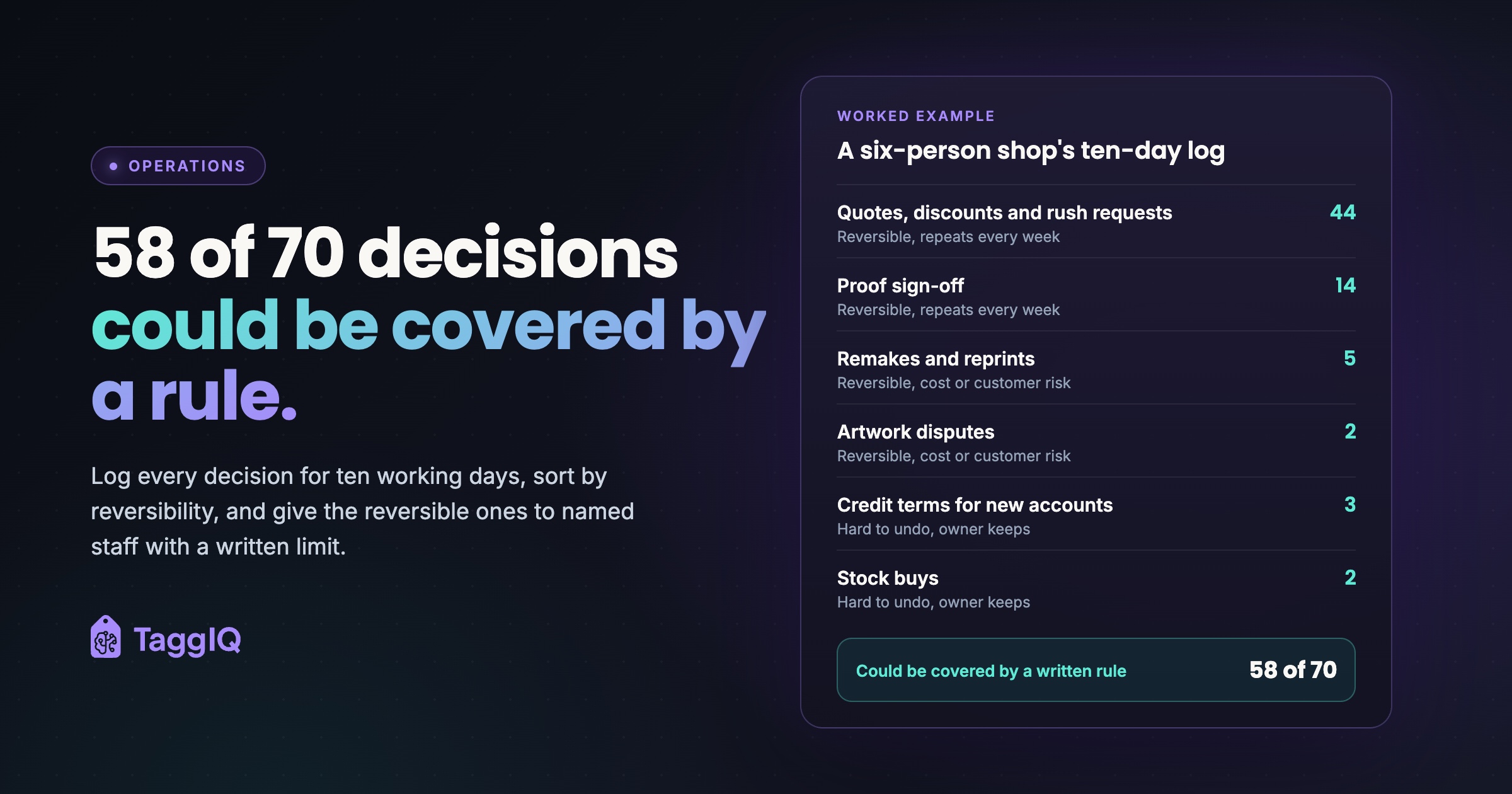
Worked example: a six-person shop's ten-day log
A screen print and embroidery shop with six staff logs 70 decisions in ten working days. Grouped by type:
- Standard quote pricing: 24
- Discounts on repeat orders: 12
- Rush requests: 8
- Proof sign-off: 14
- Remakes and reprints: 5
- Artwork disputes: 2
- Credit terms for new accounts: 3
- Stock buys: 2
Of these, 58 (quotes, discounts, rush and proofs) are reversible and repeat every week. Seven (remakes and disputes) are reversible but carry cost or customer risk. Only five (credit and stock) are hard to undo. The owner has been personally handling 58 decisions that a written rule could cover.
Step two: sort each decision into the delegation map
The same method separates “one-way door” decisions from reversible ones. Major capital spending, equity and debt, and key hires stay with the owner. Everything else is a candidate for delegation.
For a print, sign or embroidery shop, three buckets work well. Delegate with a rule means staff decide and you never see it. Delegate with escalation means staff decide inside a limit and pass it up when a trigger is crossed. Owner keeps means the decision comes to you every time.
| Decision | Bucket | Who decides | Escalation trigger |
|---|---|---|---|
| Standard quote from the price list | Delegate with a rule | Any trained staff | Margin below the floor |
| Discount on a repeat order | Delegate with escalation | Account lead | Above the discount limit or order value cap |
| Rush request | Delegate with escalation | Production lead | Would bump already-scheduled work |
| Proof sign-off | Delegate with escalation | Artwork staff with a checklist | Customer disputes the proof, or job over £[amount] |
| Remake or reprint | Delegate with escalation | Production lead | Cost above a set amount, or fault unclear |
| Artwork dispute | Delegate with escalation | Account lead | Customer refuses to pay or approve, or disputed amount over £[amount] |
| Credit terms for a new account | Owner keeps | Owner | Every time |
| Large stock buy | Owner keeps | Owner | Every time |
| Key hires | Owner keeps | Owner | Every time |
Fill in your own names and numbers. A rule with no number, such as “use your judgement on small discounts”, is not a rule. Staff will either refuse sensible requests or give too much away.
For proofs, the checklist is the rule. If you need one, the guide to artwork approvals covers what to check before a proof goes out. For rush work, pricing rush jobs and knowing when to say no helps you set the surcharge before you write it down.
Step three: write three pricing rules
Pricing decisions are the largest group in the census above (44 of 70), so start there. Three rules cover standard quotes, discounts and rush work.
Copyable pricing rules
Rule 1: Margin floor. No quote goes out below [X]% gross margin, worked out from blank cost, decoration cost and labour. Quotes below the floor go to [owner name] with the reason.
Rule 2: Discount limit. On repeat orders under £[order value], the account lead may give up to [Y]% off. The margin floor still applies after the discount. Anything larger, or on a first order, goes to [owner name].
Rule 3: Rush and setup. Rush jobs carry a [Z]% surcharge, quoted before the job is accepted. Setup fees are never waived on orders under [quantity] units. If a rush would move already-scheduled work, the production lead decides with [owner name].
Adapt the wording and figures to your shop, and have your adviser check anything that touches customer terms before you use it.
Set the floor high enough to cover your overheads and delivery as well as job costs, and test it with the profit margin calculator.
If counter staff cannot see full job costs, give them a cost sheet or a minimum price per quantity band, so they can apply the floor without seeing costings.
Worked example: the rules at work
Illustrative figures: margin floor 35%, discount limit 10% on repeat orders under £1,500, rush surcharge 25%, setup fees never waived under 48 units.
New quote. 50 embroidered polos. Blanks, digitising, run time and labour come to £640. Price at the floor: £640 ÷ 0.65 = £984.62, rounded to £985. Margin check: (£985 − £640) ÷ £985 = 35.0%. Staff send it without asking.
Repeat order. A customer reorders printed hoodies at £1,200. Job cost is £760, so margin is (£1,200 − £760) ÷ £1,200 = 36.7%. They ask for 10% off. New price £1,080, margin (£1,080 − £760) ÷ £1,080 = 29.6%. The discount is inside the limit but fails the floor. Staff can offer 2.5% off: £1,170, with a margin of 35.0%, which clears both limits. If the customer wants more, staff can quote the next quantity break that clears the floor. Any discount that takes the price below £1,170 needs owner approval.
Rush. A £985 job needed in three days, with a free slot in the schedule. Surcharge 25% of £985 = £246.25, total £1,231.25. Nothing scheduled is bumped, so the production lead accepts it.
That repeat order shows why the number has to be written down. Without the floor, a well-meaning staff member gives the full discount and the job slips below the margin you need.
Step four: record the reason on the job
A decision nobody can see cannot be repeated. Record customer decisions such as colour changes, rush fees and lost-quote reasons on the job, so the next staff member can see what happened. There is more on this in why your team forgets customer context between calls.
Add one line to the job when a rule is used or escalated: “Repeat discount within the limit, margin above the floor, approved by account lead.” When the same customer comes back, the next person knows what was agreed and why.
Step five: stop overriding, then test it
The quickest way to undo this work is to reverse a delegated call after the fact. If a staff member follows the rule and you change the answer, they learn to stop deciding. If the rule produced a bad result, change the rule and tell everyone. Leave the decision alone.
Set a review date, monthly at first. Look at the escalations. If the same one keeps coming up, the rule probably needs a new number.
Then test the map by stepping away. The same method recommends a planned owner absence to see whether the structure holds. Take two or three days off, ask staff to hold owner-keeps items until you return, and read the job notes then. Every question that would have needed you is a gap in the map.
Where software fits, and where it does not
Written rules are what make draft-and-approve tools useful. A tool can only apply your pricing tiers and decoration rules consistently if they are written down in a form it can use.
TaggIQ’s AI Co-Worker drafts quotes using customer history, pricing tier and decoration calculation, then waits for a person to approve them. It can suggest decoration pricing, including processes, setup costs and tier breakdowns, built from the shop’s own decoration rules (TaggIQ AI features). That fits the map: the tool prepares the draft, and the staff member checks it against the margin floor before it goes out.
If you are weighing up a system for this, what to check in print shop software is a useful starting point.
Your next step this week
Put a notebook by the till on Monday and start the ten-day census. When it ends, sort the list into the three buckets and write your three pricing rules with real numbers. Give each delegated decision a named owner and a review date.
See TaggIQ's AI Co-Worker See how TaggIQ's AI Co-Worker drafts quotes from your pricing tiers and decoration rules, then waits for your team to approve them.
Frequently asked questions
What if my staff do not want to make pricing decisions?
Start with the delegate-with-a-rule bucket only. A staff member checking a quote against a written margin floor is following a rule, not taking a risk, and that builds confidence before you hand over anything with escalation.
Should the margin floor be the same for every product?
Not necessarily. You can set one floor for screen print and another for embroidery or signs, as long as each is written down and staff know which applies.
How do I stop customers going around staff to reach me?
Send them back to the person who holds the decision, and back that person's answer. If you overrule in front of the customer, the customer learns to skip your staff next time.
What if a delegated decision goes wrong?
Treat it as a rule problem first. Check whether the staff member followed the written rule. If they did, change the number or the trigger and tell the team, rather than taking the decision back.

Dave
Dave writes for TaggIQ about running a profitable print, promo, sign and embroidery business: costing and estimating, margins, production flow, order workflows, pricing decisions and keeping customers coming back.