In this article 9 sections
The press is booked through next Friday and the crew has worked three Saturdays in a row. Last week you turned down a 600-piece order because you couldn’t promise the date. Sooner or later someone says it out loud: we need another person, or another machine.
The short answer is to decide with numbers, not in the middle of a crunch week. Compare all three options on the same basis: cost per extra unit at peak and off-peak volume, the break-even volume against outsourcing, how fast each one comes online, and how easily you can undo it. The rest of this article works through that, then gives you a worksheet to fill in.
Step one: check where the bottleneck really is
A new machine won’t help if the jobs are stuck somewhere else. Before you price anything, list each station: art approval, screen prep, press, embroidery heads, wide-format printer, finishing, install crew. For each one, write down the hours booked last month against the hours available.
The station with the fewest free hours is your constraint. If it’s the press, adding capacity there makes sense. If it’s art approval or screen prep, a second press will sit idle while jobs queue up in front of it. For a fuller method, see finding the bottleneck in your print shop workflow.
Next, check whether your existing equipment is idle for part of the day. If the press runs one shift and sits dark every evening, you may be short of people, not machines.
Step two: measure the demand you are losing
You can’t size the fix without knowing the gap. Starting this week, log every job you turn away or push back: the date, the quantity and the reason. After a season you’ll know two numbers, your extra units at peak and your extra units off-peak.
That second number matters most. Hiring and buying add fixed costs that you pay in the quiet months too. A spike that only lasts a season is a poor reason to sign a 60-month finance agreement.
Also look at what you can smooth out before adding supply. Firm lead times, minimum order rules and rush fees all push demand into the quieter weeks. Rush jobs: how to price them and when to say no covers the pricing side.
Step three: cost each option fully
The classic mistake is putting a machine’s price next to an hourly wage. Neither number is the real cost.
Hiring. A new hire costs more than their wage. The US Bureau of Labor Statistics publishes Employer Costs for Employee Compensation, which splits employer cost per hour worked into wages and benefits. Add payroll costs, training time and a ramp-up period while the new operator gets up to speed.
Buying a machine. Count the monthly payment, maintenance, consumables, power, floor space and install. Then remember someone still has to run it. A machine without an operator adds no capacity. For tax treatment, check IRS Publication 946, which explains depreciation and the section 179 election, and ask your tax adviser how it applies to your own purchase before you count on it.
Outsourcing. The contract decorator’s price per unit is only the start. Add freight, the extra days of turnaround, the risk of quality problems and rework, and the margin you give up on every piece.
The worked comparison
Worked example
A screen-print shop loses about 1,600 units a month in its three peak months and 600 units a month in the other nine. Each unit sells for $12 and costs $5 in blanks and ink, leaving $7 before decoration labor.
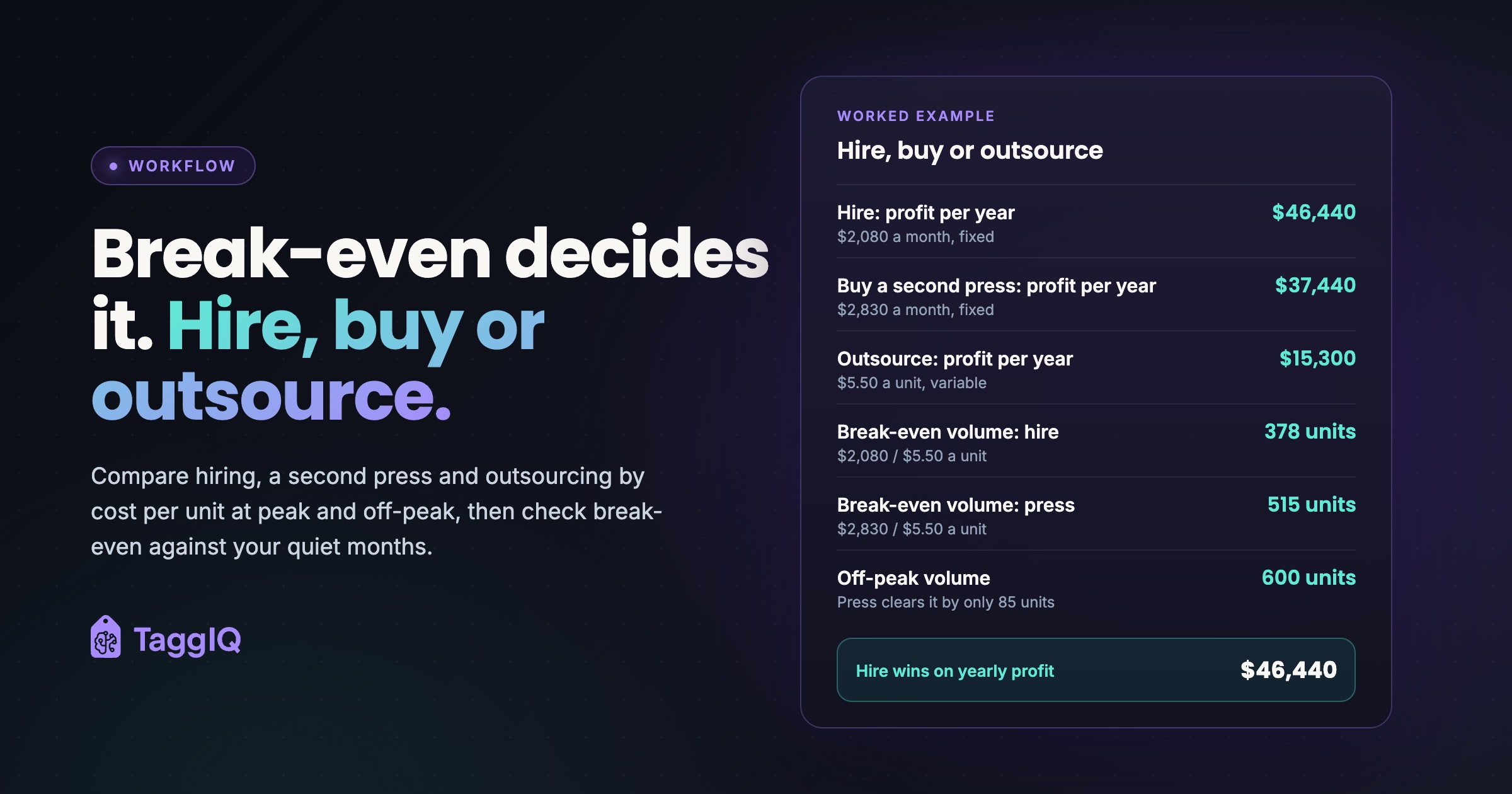
Option A: hire a part-time operator for an evening shift on the existing press. $20 an hour plus a 30% load for benefits and payroll costs is $26 an hour. At 80 hours a month that is $2,080 a month, fixed. At 25 units an hour, 80 hours covers up to 2,000 units, so the peak gap fits.
Option B: buy a second press. $30,000 financed over 60 months at about 8% interest is about $600 a month, plus $150 for maintenance and consumables. It still needs a part-time operator at $2,080. Total: $2,830 a month, fixed.
Option C: outsource the overflow. $4.50 a unit from a contract decorator plus $1.00 freight is $5.50 a unit, variable, with 3 to 5 extra days of turnaround.
Here is what each option leaves you with, using the figures above.
| Hire (A) | Buy (B) | Outsource © | |
|---|---|---|---|
| Monthly fixed cost | $2,080 | $2,830 | $0 |
| Variable cost per extra unit | $0 | $0 | $5.50 |
| Cost per unit at peak (1,600) | $1.30 | $1.77 | $5.50 |
| Cost per unit off-peak (600) | $3.47 | $4.72 | $5.50 |
| Profit per peak month | $9,120 | $8,370 | $2,400 |
| Profit per off-peak month | $2,120 | $1,370 | $900 |
| Profit per year (3 peak + 9 off-peak) | $46,440 | $37,440 | $15,300 |
| Time to bring online | 4 to 8 weeks to train | Weeks to deliver, plus operator | Days |
| How easy to reverse | Moderate | Hard: 60 months of payments | Easy |
Profit here means the $7 per unit times extra units, minus the option’s costs. For outsourcing that is $1.50 a unit ($7 minus $5.50). Profit for the press is $11,200 minus $2,830 at peak, and $4,200 minus $2,830 off-peak.
The break-even volume
Break-even tells you the monthly volume where owning beats outsourcing. Divide the fixed monthly cost by what you save per unit by not outsourcing.
Worked example
For the hire: $2,080 divided by $5.50 is about 378 units a month.
For the press: $2,830 divided by $5.50 is about 515 units a month.
The shop’s off-peak volume is 600 units. Both options clear break-even, but the press clears it by only 85 units. If off-peak demand slipped to 500 units, the press would cost more than outsourcing for nine months of the year, and the payments would keep coming.
What the numbers say
In this example, the hire wins. The press is already there and idle in the evenings, so a person adds capacity for less fixed cost than a person plus a machine. The second press only makes sense once the existing press is busy on both shifts, which isn’t the case here.
If your existing press is already full on both shifts, the hire option disappears. Then compare the second press with outsourcing, using the 515-unit break-even.
Outsourcing earns the least per unit but carries no fixed risk. It’s the right tool for spikes above what your own team can handle, and for techniques you don’t do in-house. Keep the customer relationship and the artwork approval yourself.
Three risks the table hides: ramp-up, overtime and rework
Check three things before trusting the table.
First, the ramp. A new operator in the first month might run at half speed, so plan the hire six to eight weeks before the season, not during it.
Second, overtime. It’s the right bridge for a few weeks. Run it for months and you get tired crews, more misprints and resignations, which leave you with less capacity than before.
Third, outsourcing quality. Price one rework job into your outsourcing number: replacement blanks, freight back and the lost days.
Your capacity decision worksheet
Fill this in with your own figures. Do it before the busy season.
| Line | Hire | Buy | Outsource |
|---|---|---|---|
| 1. Bottleneck station this fixes | |||
| 2. Extra units a month at peak | |||
| 3. Extra units a month off-peak | |||
| 4. Fixed monthly cost (fully loaded) | |||
| 5. Variable cost per extra unit | |||
| 6. Cost per unit at peak: (line 4 divided by line 2) plus line 5 | |||
| 7. Cost per unit off-peak: (line 4 divided by line 3) plus line 5 | |||
| 8. Break-even volume: line 4 divided by (outsource cost per unit minus line 5) | n/a | ||
| 9. Weeks to bring online | |||
| 10. Commitment length if demand drops | |||
| 11. Quality or turnaround risk |
The decision rule is simple. If your off-peak volume on line 3 is comfortably above the break-even on line 8, owning that capacity is worth considering. If it’s close or below, outsource the peaks and review again in six months with fresh numbers.
Knowing your real capacity has a second benefit. Once you know how many hours each station has free, you can give honest lead times on every quote and turn quotes around faster. Quoting speed explains why that matters for winning work.
Your next step this week
Start the lost-work log today and fill in lines 1 to 3 of the worksheet from last month’s bookings.
See the Scheduling Agent TaggIQ is scoping a Scheduling Agent that plans production and install dates back from the delivery date, and you can see the proposed build and book a demo.
Frequently asked questions
Should I lease or buy the machine?
Compare the monthly payment, total cost over the term and what happens at the end of it, then put the monthly figure on line 4 of the worksheet. Check the tax side with your adviser and IRS Publication 946, linked above, before deciding.
What if my bottleneck is the install crew, not a machine?
Use the same worksheet with crew hours as the unit. Outsourcing installs to a contract installer is the outsource column, and a new installer is the hire column.
How often should I redo this?
Redo it twice a year: once before your busy season and once after it, using the lost-work log to update your peak and off-peak volumes.

Dave
Dave writes for TaggIQ about running a profitable print, promo, sign and embroidery business: costing and estimating, margins, production flow, order workflows, pricing decisions and keeping customers coming back.