In this article 17 sections
- Start from the decision, not the metric
- Two things to fix before you start
- The question bank at a glance
- Where the money is made: monthly questions
- 1. Which customers make us the most gross margin, not the most revenue?
- 2. Which decoration method or product category has the thinnest margin?
- 3. Is average order size rising or falling?
- Where the money is waiting: weekly questions
- 4. What share of our quotes become orders, and how long do they take?
- 5. Which unpaid invoices should we chase this week?
- 6. Which regular customers have gone quiet past their usual reorder interval?
- How the team and the shop perform: monthly questions
- 7. How does each salesperson's conversion rate and margin compare with the team average?
- 8. Where do estimated and actual job costs differ, and how often are jobs reworked or late?
- Running the weekly review
- Traps that make the answers wrong
- Where a system helps
You already have reports. Your shop system or accounting package can show sales by month, an aging list of unpaid invoices and probably a list of open quotes. What you don’t have is an analyst, or the hours to stare at those numbers until they mean something. So the reports get a quick look and decisions still run on gut feel.
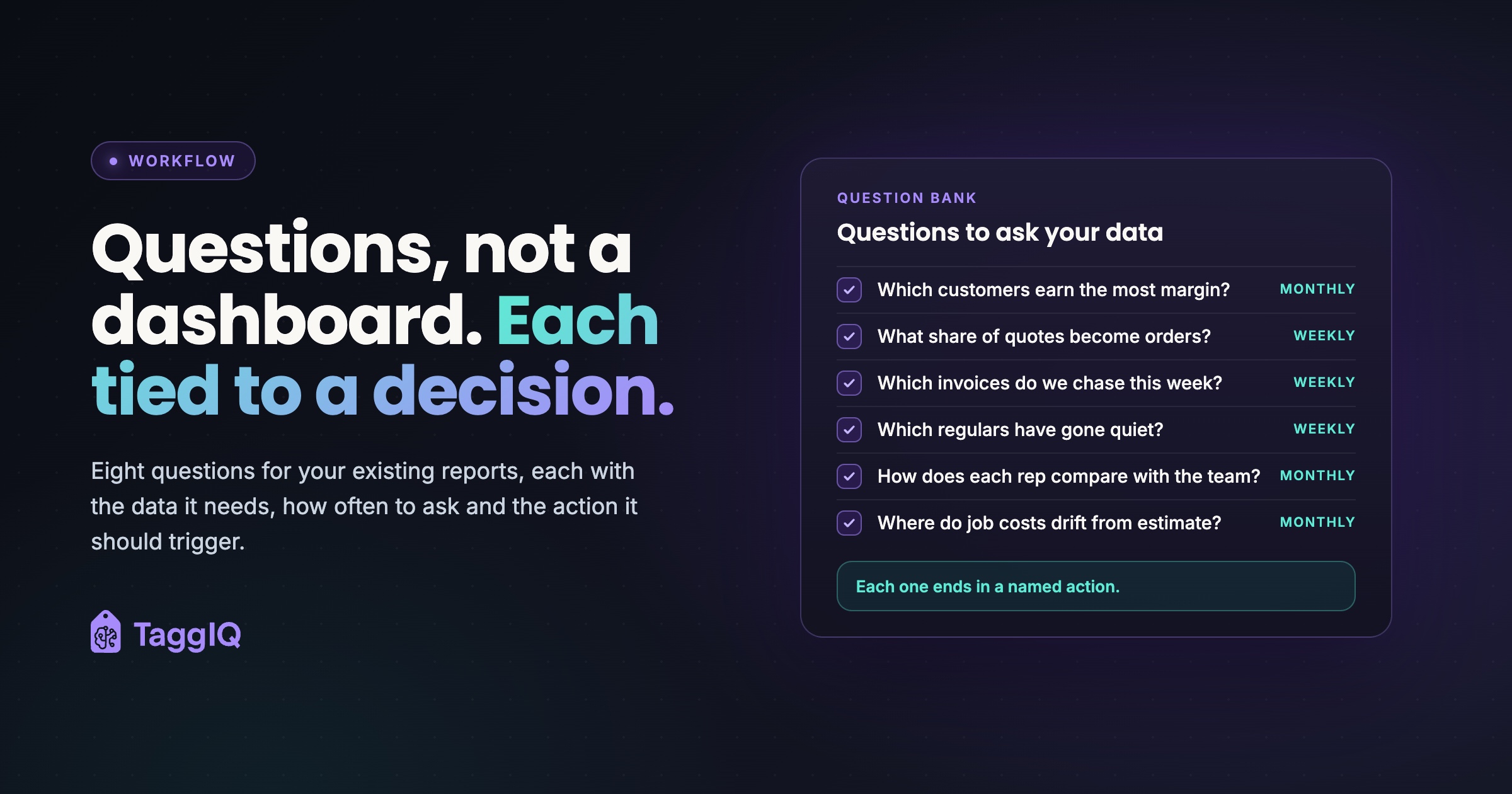
Here is the short answer. Business intelligence for a small shop doesn’t have to be a dashboard. It can be a short list of questions, each tied to a decision. Below are eight. Each comes with the data it needs, where that data usually lives, how often to ask it and which result should lead to which action. Run them in a short weekly review and your existing reports start doing real work.
Start from the decision, not the metric
A KPI list tells you what to measure. It doesn’t tell you what to do when a number looks bad.
Here’s a simpler test. For every number you look at, you should be able to finish the sentence “If this looks bad, I will…”. If you can’t, the number is decoration. Every question below comes with that sentence already written.
Two things to fix before you start
Margin questions need cost per order. If your job records leave out blank goods, freight, setup time or revisions, your margin reports will look healthier than the shop really is. The hidden costs that quietly destroy print shop margins covers the usual gaps. Without cost per order, you can’t honestly answer the customer, method and rep margin questions.
Keep invoiced and collected revenue apart. The US Small Business Administration explains that the accrual method records a sale when it is completed and the cash method records it when payment is received, and that the cash method shows cash flow clearly. Whatever method your books use, look at both views. A strong invoicing month can still leave you short of cash. Check with your accountant on which method applies to your own reporting and tax obligations.
The question bank at a glance
| Question | Data needed | Where it usually lives | How often | Decision it informs |
|---|---|---|---|---|
| Which customers make us the most gross margin? | Revenue and full job cost per order, by customer | Invoices plus job costing or a spreadsheet | Monthly | Pricing and account focus |
| Which decoration method or category has the thinnest margin? | Margin per order by method and product category | Job records | Monthly | Price review or minimum quantities |
| Is average order size rising or falling? | Average order value by period, compared with a year earlier | Sales reports | Monthly | Bundling and minimums |
| What share of quotes become orders, and how fast? | Quotes sent, quotes won, sent and won dates, lost reasons | Quoting tool, CRM or email | Weekly | Follow-up cadence |
| Which unpaid invoices should we chase this week? | Open invoices by days outstanding and amount | Accounts receivable aging | Weekly | Collection calls |
| Which regulars have gone quiet? | Order dates per customer and the median gap between their last three or four orders | Order history | Weekly | Reorder outreach |
| How does each rep compare with the team average? | Conversion rate and margin by rep | Quotes plus margin data | Monthly | Coaching |
| Where do estimated and actual costs differ, and how often are jobs late or reworked? | Estimate, actual cost, remakes, on-time delivery | Production records, if kept | Monthly | Estimating and production fixes |
The thresholds in the worked examples below are illustrative starting points, not industry benchmarks. After a few months of readings, adjust them to fit your shop.
Watch the sample size too. In a shop doing a few dozen orders a month, one or two jobs can move a percentage by several points. Compare reps, decoration methods and order size on rolling three-month figures. Don’t act on a percentage built from a handful of jobs. Set aside any single unusually large order when you check average order value.
Where the money is made: monthly questions
1. Which customers make us the most gross margin, not the most revenue?
Ranking customers by revenue flatters the big accounts that push for discounts, rush slots and free revisions. Rank them by gross profit dollars and by margin percentage instead.
If you see a top-revenue customer in the bottom third for margin percentage, then review their pricing before the next quote and list what is eating the margin: discounts, rush work, extra proofs or split shipments.
Worked example
An illustrative embroidery and screen print shop has 6 staff, two salespeople and about 40 orders a month. Over one quarter, a corporate account brings in $6,000 at a 22% gross margin, which is $1,320 of gross profit. A youth sports club brings in $2,500 at 48%, which is $1,200. The corporate account brings in 2.4 times the revenue but only $120 more gross profit. Dropping the account isn’t the fix. The fix is to find out what its discounts and rush requests are costing.
2. Which decoration method or product category has the thinnest margin?
It is easy to price one method carefully and let another drift, especially small runs where setup time is spread over very few pieces. Decoration pricing and the hidden margins in setup and run charges goes deeper on where that drift comes from.
If you see a method or category sitting well below your shop’s average margin, then choose one fix: raise the price, add a setup charge or set a minimum quantity.
Worked example
The illustrative shop reviews any method that sits 10 points or more below its average margin. Over the last three months, its average gross margin across all orders is 38%. Heat-applied transfers on orders under 24 pieces come in at 21% across 26 orders over the same three months, which is 17 points below average. A setup charge on those small runs is the obvious first thing to test.
3. Is average order size rising or falling?
A falling average order value with steady order counts means more work for each dollar earned. Decorated apparel work can be seasonal, so compare each period with the same period last year, not with the month before.
If you see the rolling three-month average order value fall below the same three months last year, with any single unusually large order set aside, then check whether small orders are growing as a share of the total, and think about minimums or simple bundles such as a second print location or matching headwear.

Where the money is waiting: weekly questions
4. What share of our quotes become orders, and how long do they take?
Conversion rate tells you how well quotes land. Days to close tells you when a follow-up is due. Use the median days to close for won quotes, not the average, so a few quotes that took months don’t push the trigger late. Neither number explains a drop unless someone records why quotes were lost. That’s also why notes and customer history matter, as covered in customer context in a print shop.
If you see a quote pass your median days to close with no reply, then follow it up that day. If conversion drops for a month, then read the lost reasons before you change prices.
Worked example
The illustrative shop sent 60 quotes last month and won 21, a 35% conversion rate. Won quotes had a median close of 8 days. Any open quote older than 8 days goes on this week’s follow-up list.
5. Which unpaid invoices should we chase this week?
Sort accounts receivable by days outstanding, then by amount. Work through the oldest and largest first.
If you see a customer on the overdue list month after month, then review their deposit and payment terms before you accept the next order.
Worked example
The illustrative shop has $14,200 in open invoices. Of that, $3,100 sits in three invoices over 60 days old. Those three get calls first, before anything newer.
6. Which regular customers have gone quiet past their usual reorder interval?
Some repeat customers order on a rhythm: before a sports season, for an annual event or when new staff start. A missed rhythm can be an easy sale you haven’t asked for yet.
To find a customer’s usual interval, take the median number of days between their last three or four orders. Only apply the trigger to customers with at least three orders.
If you see that a regular’s last order is well past their usual interval, then contact them with their last order and a simple reorder option.
Worked example
The illustrative shop flags a regular once the gap since their last order passes 1.5 times their usual interval. A club usually orders every 90 days or so, ahead of each season, so its trigger is 135 days. It’s now 140 days since its last order, so it goes on this week’s outreach list.
How the team and the shop perform: monthly questions
7. How does each salesperson’s conversion rate and margin compare with the team average?
Look at conversion and margin together, on rolling three-month figures. Either one alone can mislead you.
If you see a rep well above average on one measure and below on the other, then coach the specific habit behind it rather than ranking reps against each other.
Worked example
In the illustrative shop, over the last three months, Rep A converts 42% of about 90 quotes at a 31% margin. Rep B converts 28% of about 90 quotes at a 40% margin. The team average is 35% conversion at about a 35% margin. Rep A may be winning by discounting. Rep B may be quoting high or following up too slowly. Each needs a different conversation.
8. Where do estimated and actual job costs differ, and how often are jobs reworked or late?
You may not be able to answer this question yet if production data is not recorded. A PRINTING United Alliance article recommends three company-wide measures: on-time, in-full (OTIF) deliveries as a percentage of total jobs, cost of spoiled work as a percentage of sales, and customer complaints.
Start small. Put a reason code on every remake and every late job, and record actual hours on a sample of jobs.
If you see actual cost run well over the estimate on the same job type more than once in a month, then find the cost line that overran and update the estimate for that line.
Worked example
The illustrative shop treats an overrun above 10% as significant. This month, two left-chest embroidery jobs ran 14% and 12% over estimate. Both overruns came from digitizing new designs, so the shop raises its digitizing allowance for new designs above a set stitch count, not its run rate for left-chest jobs. Reorders of those designs keep their current price.
Running the weekly review
Hold the weekly session on the same day each week and keep it to the cash and pipeline questions:
- Overdue invoices: assign each call to a named person.
- Open quotes past your median days to close: assign follow-ups.
- Lapsed regulars: pick who gets contacted.
- Write down no more than three actions, each with an owner and a date.
In the first session of each month, add the margin, order size, rep and job cost questions.
If you want to compare your financial ratios with peers, PRINTING United Alliance runs a Key Financial Ratios survey covering your most recent 12 months, including gross sales, payroll, gross profit, EBITDA and accounts receivable. You don’t need to be an Alliance member to take part. Submissions are confidential, and only participants receive the full report with industry averages.
Traps that make the answers wrong
One trap is treating busy as profitable. More orders, less profit? explains how small, complex jobs can fill bottleneck hours while earning less per hour. Some shops track so many metrics that none of them gets attention. Some never record why a quote was lost. Some compare a seasonal month with the month before it. If a question hasn’t changed a decision in a quarter, replace it.
Where a system helps
You can answer most of these from accounting software and a careful spreadsheet. TaggIQ reporting covers customer and decoration-method margins, pipeline conversion and collections, shows each customer’s order frequency and each rep’s conversion against the team average, and can send a scheduled weekly summary to whoever attends the review. Spotting lapsed regulars, margin by rep, production measures and estimate-versus-actual variance need separate analysis, so keep those in your own log for now.
Your next step this week: book a short slot, print the table above and run the three weekly questions on overdue invoices, open quotes and lapsed regulars against the reports you already have.
See TaggIQ reporting See how TaggIQ reporting answers the margin, pipeline and collections questions from your connected quotes, orders and invoices.
Frequently asked questions
I only have accounting software and a spreadsheet. Can I still run these questions?
Yes, for most of them. Your accounting package's receivables aging tells you which invoices to chase. A quote spreadsheet with sent date, won date and lost reason covers conversion and days to close. Margin questions need cost columns added to each order, covering blank goods, decoration, freight and setup time, before the answers mean anything.
My margin report looks great. Should I trust it?
Check what the job cost includes first: does it leave out freight, setup time, extra proofs or revisions, or blanks ordered beyond the job quantity? Pick five recent jobs, add up every cost by hand, and compare the result with the report.

Emma
Emma writes for TaggIQ about practical AI and automation for print, promo, sign and embroidery businesses: AI assistants and agents, quoting and follow-up workflows, customer experience and keeping people in charge of the decisions that matter.